岂 (qǐ) means "How (rhetorical)" in Chinese. It has 6 strokes with the radical 山, and is HSK Level 7.
Rated 3.2/5 in difficulty (challenging).
Harder than 10% of HSK Level 7 characters.
Appears in 3+ common words including 岂有此理 (qǐ yǒu cǐ lǐ), 岂止 (qǐ zhǐ), 岂敢 (qǐ gǎn).
Due to its 6 strokes, Hanzi Writer's error detection shows 岂 requires focused practice — most learners need 10+ attempts for consistent accuracy.
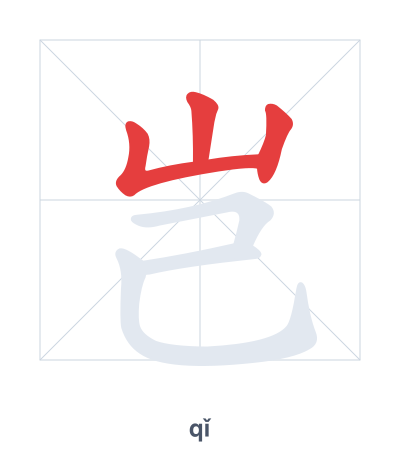
Open Hanzi Writer to see the animated stroke order and practice writing 岂 with real-time feedback.
The character 岂 (qǐ) is written with 6 strokes. Follow the standard Chinese stroke order: top to bottom, left to right, outside before inside. The radical 山 is one of its key components.
Practice the correct stroke order with the Hanzi Writer app to see animated stroke-by-stroke guidance with real-time feedback.
岂 means How (rhetorical).
As an HSK Level 7 character, 岂 is an intermediate-level character.
Originally a pictograph of a decorated drum, 岂 was borrowed for its sound to mean 'how' in rhetorical questions. The modern form contains the 'mountain' radical (山) atop a component resembling 己 (self), though this structure is a simplification from the ancient drum image.
💡 Memory Tip: A mountain (山) asks rhetorically, 'How (岂) can a tiny self (己) ever move me?'
这真是岂有此理!
zhè zhēn shì qǐ yǒu cǐ lǐ
This is absolutely ridiculous!
岂止是他一个人。
qǐ zhǐ shì tā yí gè rén
It is not just him alone.
我岂敢不听话。
wǒ qǐ gǎn bù tīng huà
How would I dare to be disobedient?
Open Hanzi Writer to see the animated stroke order and practice writing 岂 with real-time feedback.
✨ Animated stroke order · Handwriting recognition · HSK-graded practice · Free to use
岂 is composed of the radical 山 (mountain) on top and 己 (self) on the bottom. The character's meaning of a rhetorical 'how' does not come directly from these components; instead, 岂 is a simplified form that functions as a phonetic loan. The mountain radical hints at the character's appearance but not its meaning.