岁 (suì) means "Year / Age" in Chinese. It has 6 strokes with the radical 山, and is HSK Level 1.
Rated 2.7/5 in difficulty (moderate).
Harder than 44% of HSK Level 1 characters.
Appears in 3+ common words including 几岁 (jǐ suì), 岁数 (suì shù), 万岁 (wàn suì).
Hanzi Writer's stroke validation shows learners typically need 5-8 attempts to write 岁 with correct proportion and order.
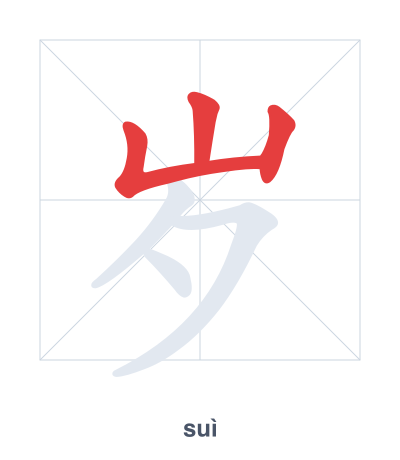
Open Hanzi Writer to see the animated stroke order and practice writing 岁 with real-time feedback.
The character 岁 (suì) is written with 6 strokes. Follow the standard Chinese stroke order: top to bottom, left to right, outside before inside. The radical 山 is one of its key components.
Practice the correct stroke order with the Hanzi Writer app to see animated stroke-by-stroke guidance with real-time feedback.
岁 means Year / Age.
As an HSK Level 1 character, 岁 is among the first characters beginners learn.
The character 岁 originally depicted a foot (止) stepping over a dagger-axe (戉), symbolizing the passage of a year's cycle. In the modern simplified form, the top 山 (mountain) and bottom 夕 (evening) together suggest the many days (like mountain peaks) ending with evenings, representing the flow of a year.
💡 Memory Tip: Picture a mountain (山) that morphs into the setting sun (夕) at the close of a year, reminding you that 岁 means year or age.
你今年几岁了?
nǐ jīn nián jǐ suì le
How old are you?
他的岁数很大了。
tā de suì shù hěn dà le
He is quite old.
大家高呼万岁。
dà jiā gāo hū wàn suì
Everyone shouted 'Long live!'
Open Hanzi Writer to see the animated stroke order and practice writing 岁 with real-time feedback.
✨ Animated stroke order · Handwriting recognition · HSK-graded practice · Free to use
岁 is composed of the radical 山 (mountain) on top and 夕 (evening) below. Although the parts do not directly picture a year or age, the mountain-and-sunset image is traditionally linked to the passage of time. The radical 山 gives the character its visual category, while the whole form is used for 'year' and 'age'.