峭 (qiào) means "steep; precipitous" in Chinese. It has 10 strokes with the radical 山.
Rated 4.2/5 in difficulty (advanced).
Appears in 3+ common words including 陡峭 (dǒu qiào), 峭壁 (qiào bì), 峻峭 (jùn qiào).
Due to its 10 strokes, Hanzi Writer's error detection shows 峭 requires focused practice — most learners need 10+ attempts for consistent accuracy.
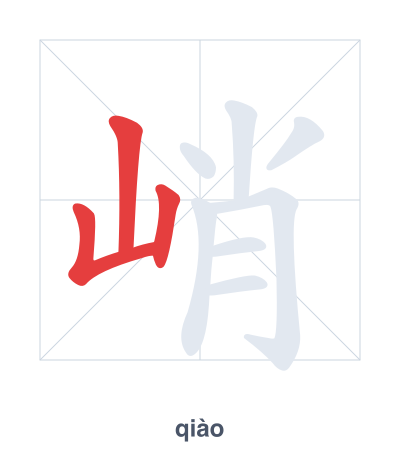
Open Hanzi Writer to see the animated stroke order and practice writing 峭 with real-time feedback.
The character 峭 (qiào) is written with 10 strokes. Follow the standard Chinese stroke order: top to bottom, left to right, outside before inside. The radical 山 is one of its key components.
Practice the correct stroke order with the Hanzi Writer app to see animated stroke-by-stroke guidance with real-time feedback.
峭 means steep; precipitous.
峭 combines the radical 山 (mountain) with 肖 (resemble), which gives the sound. It depicts a mountain that is so sharp and narrow that it seems to resemble a blade, conveying the meaning of steepness and precipitousness.
💡 Memory Tip: Picture a mountain (山) with a tiny person (肖, like a small body) struggling to climb its impossibly steep face.
这条路很陡峭。
zhè tiáo lù hěn dǒu qiào
This road is very steep.
他在爬峭壁。
tā zài pá qiào bì
He is climbing a cliff.
山势很峻峭。
shān shì hěn jùn qiào
The mountain terrain is very steep and craggy.
Open Hanzi Writer to see the animated stroke order and practice writing 峭 with real-time feedback.
✨ Animated stroke order · Handwriting recognition · HSK-graded practice · Free to use
峭 is made of the radical 山 (mountain) on the left and the phonetic component 肖 (xiào) on the right. The mountain radical indicates the meaning relates to terrain, while 肖 contributes the sound qiào. Together they describe a steep, precipitous mountain.