屺 (qǐ) means "Bare hill (without trees)" in Chinese. It has 6 strokes with the radical 山.
Rated 3.2/5 in difficulty (challenging).
Appears in 3+ common words including 屺山 (qǐ shān), 陟屺 (zhì qǐ), 屺岵 (qǐ hù).
Due to its 6 strokes, Hanzi Writer's error detection shows 屺 requires focused practice — most learners need 10+ attempts for consistent accuracy.
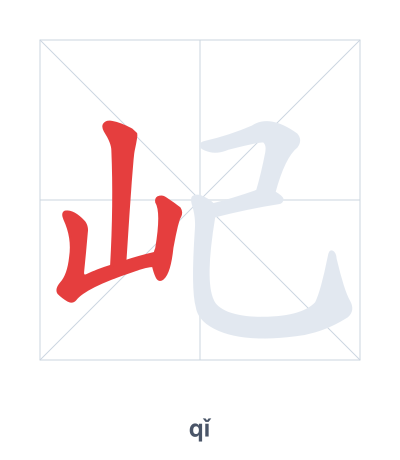
Open Hanzi Writer to see the animated stroke order and practice writing 屺 with real-time feedback.
The character 屺 (qǐ) is written with 6 strokes. Follow the standard Chinese stroke order: top to bottom, left to right, outside before inside. The radical 山 is one of its key components.
Practice the correct stroke order with the Hanzi Writer app to see animated stroke-by-stroke guidance with real-time feedback.
屺 means Bare hill (without trees).
屺 is a phono-semantic compound: the radical 山 (mountain/hill) indicates the meaning—a landform—while the component 己 (jǐ) supplies the sound (qǐ). Together they denote a hill that is bare of trees, i.e., a naked or treeless mound.
💡 Memory Tip: Picture a barren hill (山) with a lonely '己' shaped rock jutting out, leaving no room for trees.
屺山在远方。
qǐ shān zài yuǎn fāng
The bare mountain is in the distance.
他在陟屺思亲。
tā zài zhì qǐ sī qīn
He is on the hill thinking of his parents.
屺岵之思很感人。
qǐ hù zhī sī hěn gǎn rén
The longing for one's parents is very touching.
Open Hanzi Writer to see the animated stroke order and practice writing 屺 with real-time feedback.
✨ Animated stroke order · Handwriting recognition · HSK-graded practice · Free to use
屺 is composed of the radical 山 (mountain) on the left and 己 (jǐ, self) on the right. The mountain radical indicates the character relates to mountains or hills, while the right side 己 gives the pronunciation qǐ. Together, they form the idea of a bare hill—a mountain without trees.