镶 (xiāng) means "to inlay; to set; to border" in Chinese. It has 22 strokes with the radical 钅, and is HSK Level 7.
Rated 4.2/5 in difficulty (advanced).
Harder than 95% of HSK Level 7 characters.
Appears in 3+ common words including 镶嵌 (xiāng qiàn), 镶牙 (xiāng yá), 镶边 (xiāng biān).
Due to its 22 strokes, Hanzi Writer's error detection shows 镶 requires focused practice — most learners need 10+ attempts for consistent accuracy.
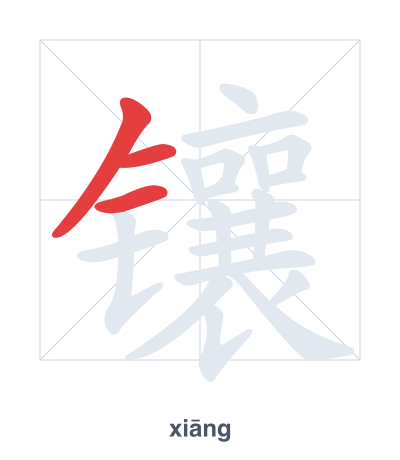
Open Hanzi Writer to see the animated stroke order and practice writing 镶 with real-time feedback.
The character 镶 (xiāng) is written with 22 strokes. Follow the standard Chinese stroke order: top to bottom, left to right, outside before inside. The radical 钅 is one of its key components.
Practice the correct stroke order with the Hanzi Writer app to see animated stroke-by-stroke guidance with real-time feedback.
镶 means to inlay; to set; to border.
As an HSK Level 7 character, 镶 is an intermediate-level character.
This character combines the radical 钅 (metal/gold) with 襄, which originally depicted a person carrying a bag and now provides the pronunciation. The meaning 'to inlay' or 'set' comes from the idea of embedding metal or gems into a surface, like setting a jewel into gold.
💡 Memory Tip: Picture a goldsmith (钅) carefully hammering a sparkling gem into a ring, while the 襄 part looks like two hands holding the jewel steady.
戒指上镶嵌着钻石。
jiè zhǐ shàng xiāng qiàn zhe zuàn shí
The ring is set with diamonds.
爷爷去医院镶牙了。
yé yé qù yī yuàn xiāng yá le
Grandpa went to the hospital to get dentures.
这件衣服有金色的镶边。
zhè jiàn yī fú yǒu jīn sè de xiāng biān
This piece of clothing has a gold trim.
Open Hanzi Writer to see the animated stroke order and practice writing 镶 with real-time feedback.
✨ Animated stroke order · Handwriting recognition · HSK-graded practice · Free to use
The character 镶 is composed of the metal radical 钅 on the left and the phonetic component 襄 on the right. The metal radical hints at the meaning of working with metal or precious materials, while 襄 provides the pronunciation xiāng and gives the idea of "assisting" or "surrounding." Together, they convey the action of setting or inlaying one material into another, like embedding gems into metal.