岌 (jí) means "High and steep; precarious" in Chinese. It has 6 strokes with the radical 山.
Rated 3.2/5 in difficulty (challenging).
Appears in 3+ common words including 岌岌可危 (jí jí kě wēi), 岌岌 (jí jí), 岌嶪 (jí yè).
Due to its 6 strokes, Hanzi Writer's error detection shows 岌 requires focused practice — most learners need 10+ attempts for consistent accuracy.
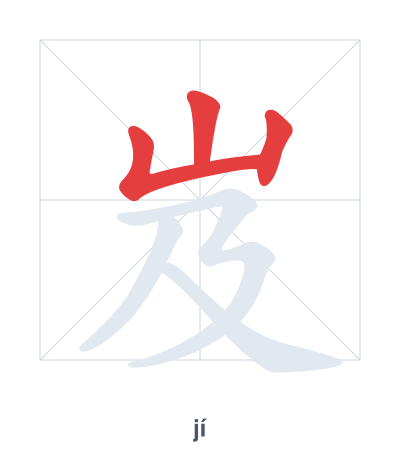
Open Hanzi Writer to see the animated stroke order and practice writing 岌 with real-time feedback.
The character 岌 (jí) is written with 6 strokes. Follow the standard Chinese stroke order: top to bottom, left to right, outside before inside. The radical 山 is one of its key components.
Practice the correct stroke order with the Hanzi Writer app to see animated stroke-by-stroke guidance with real-time feedback.
岌 means High and steep; precarious.
岌 combines the radical 山 (mountain) with 及 (jí, meaning 'to reach, extend'), suggesting a mountain that extends upward sharply. The character conveys the idea of extreme height and steepness, hence 'precarious.'
💡 Memory Tip: Picture a mountain (山) so steep you must reach (及) out with both arms just to keep from falling—that's 岌.
他的处境岌岌可危。
tā de chǔ jìng jí jí kě wēi
His situation is precarious.
形势非常岌岌。
xíng shì fēi cháng jí jí
The situation is very critical.
山势十分岌嶪。
shān shì shí fēn jí yè
The mountain terrain is very high and steep.
Open Hanzi Writer to see the animated stroke order and practice writing 岌 with real-time feedback.
✨ Animated stroke order · Handwriting recognition · HSK-graded practice · Free to use
The character 岌 is composed of the radical 山 (mountain) on the left and 及 (jí, meaning "to reach") on the right. The radical 山 connects the character to mountains, while 及 adds the sense of reaching a high, steep point. Together they convey the idea of a mountain that is extremely steep and dangerous.