屹 (yì) means "Towering" in Chinese. It has 6 strokes with the radical 山, and is HSK Level 7.
Rated 3.2/5 in difficulty (challenging).
Harder than 10% of HSK Level 7 characters.
Appears in 3+ common words including 屹立 (yì lì), 屹然 (yì rán), 屹立不倒 (yì lì bù dào).
Due to its 6 strokes, Hanzi Writer's error detection shows 屹 requires focused practice — most learners need 10+ attempts for consistent accuracy.
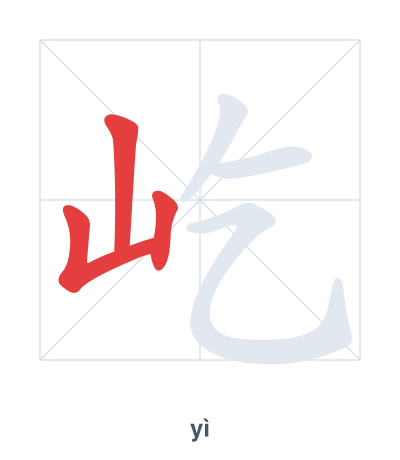
Open Hanzi Writer to see the animated stroke order and practice writing 屹 with real-time feedback.
The character 屹 (yì) is written with 6 strokes. Follow the standard Chinese stroke order: top to bottom, left to right, outside before inside. The radical 山 is one of its key components.
Practice the correct stroke order with the Hanzi Writer app to see animated stroke-by-stroke guidance with real-time feedback.
屹 means Towering.
As an HSK Level 7 character, 屹 is an intermediate-level character.
屹 is a phono-semantic compound: the left component 山 (mountain) indicates towering height, while the right component 乞 (originally meaning 'beg' but here phonetic) gives the pronunciation yì. Together, they evoke an image of a mountain standing tall and imposing.
💡 Memory Tip: Picture a mountain (山) that is so tall it begs (乞) the clouds to come closer, towering above everything.
大楼屹立在市中心。
dà lóu yì lì zài shì zhōng xīn
The building stands tall in the city center.
他屹然不动。
tā yì rán bù dòng
He stood firm and motionless.
这座塔屹立不倒。
zhè zuò tǎ yì lì bù dào
This tower stands tall and firm.
Open Hanzi Writer to see the animated stroke order and practice writing 屹 with real-time feedback.
✨ Animated stroke order · Handwriting recognition · HSK-graded practice · Free to use
The character 屹 is made of two parts: the radical 山 (mountain) on the left and 乞 (yì, a phonetic component) on the right. The mountain radical connects to the idea of something tall and stable, while 乞 provides the sound — together they create the meaning of standing tall like a mountain.