峨 (é) means "lofty; high" in Chinese. It has 10 strokes with the radical 山.
Rated 4.2/5 in difficulty (advanced).
Appears in 3+ common words including 峨眉山 (é méi shān), 巍峨 (wēi é), 峨峨 (é é).
Due to its 10 strokes, Hanzi Writer's error detection shows 峨 requires focused practice — most learners need 10+ attempts for consistent accuracy.
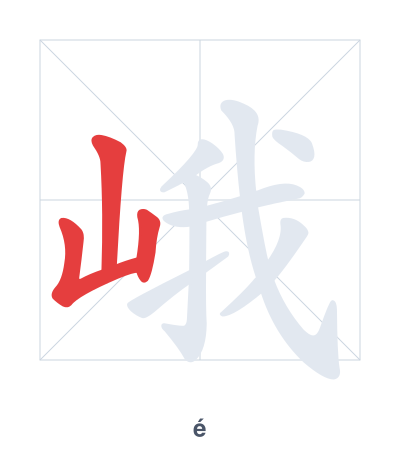
Open Hanzi Writer to see the animated stroke order and practice writing 峨 with real-time feedback.
The character 峨 (é) is written with 10 strokes. Follow the standard Chinese stroke order: top to bottom, left to right, outside before inside. The radical 山 is one of its key components.
Practice the correct stroke order with the Hanzi Writer app to see animated stroke-by-stroke guidance with real-time feedback.
峨 means lofty; high.
峨 is a phono-semantic compound: the radical 山 (mountain) indicates the meaning of height or loftiness, while 我 (wǒ, meaning 'self') provides the pronunciation (é). Together, they evoke a mountain that rises grandly, as if asserting its own lofty presence.
💡 Memory Tip: Imagine standing on a mountain (山) so high that you point to yourself (我) and shout, 'I am the tallest!'
我想去峨眉山。
wǒ xiǎng qù é méi shān
I want to go to Mount Emei.
城堡非常巍峨。
chéng bǎo fēi cháng wēi é
The castle is very majestic.
高山峨峨。
gāo shān é é
The high mountains are towering and majestic.
Open Hanzi Writer to see the animated stroke order and practice writing 峨 with real-time feedback.
✨ Animated stroke order · Handwriting recognition · HSK-graded practice · Free to use
峨 is made of the radical 山 (mountain) on the left and the component 我 on the right. The mountain radical directly connects to the meaning of high or lofty, while 我 originally gave a phonetic clue (though the tones differ in modern Chinese). Together they emphasize a sense of towering height associated with mountains.