隶 (lì) means "subordinate; clerical script" in Chinese. It has 8 strokes with the radical 隶, and is HSK Level 7.
Rated 3/5 in difficulty (moderate).
Harder than 8% of HSK Level 7 characters.
Appears in 3+ common words including 隶书 (lì shū), 隶属 (lì shǔ), 奴隶 (nú lì).
Hanzi Writer's stroke validation shows learners typically need 5-8 attempts to write 隶 with correct proportion and order.
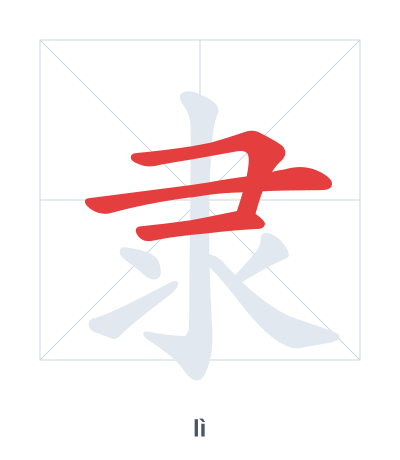
Open Hanzi Writer to see the animated stroke order and practice writing 隶 with real-time feedback.
The character 隶 (lì) is written with 8 strokes. Follow the standard Chinese stroke order: top to bottom, left to right, outside before inside. The radical 隶 is one of its key components.
Practice the correct stroke order with the Hanzi Writer app to see animated stroke-by-stroke guidance with real-time feedback.
隶 means subordinate; clerical script.
As an HSK Level 7 character, 隶 is an intermediate-level character.
隶 originally depicted a hand (又) grabbing an animal's tail (尾), symbolizing capturing or subduing someone into a subordinate position. Over time, it also came to represent the clerical script style of calligraphy, which was used by government clerks.
💡 Memory Tip: Picture a hand (the top part 彐) yanking a wavy tail (the bottom part resembling 水) to force it into submission—that's a 'subordinate' being controlled.
我在学习写隶书。
wǒ zài xué xí xiě lì shū
I am learning to write clerical script.
这个部门隶属学校。
zhè ge bù mén lì shǔ xué xiào
This department is affiliated with the school.
奴隶获得了自由。
nú lì huò dé le zì yóu
The slaves gained their freedom.
Open Hanzi Writer to see the animated stroke order and practice writing 隶 with real-time feedback.
✨ Animated stroke order · Handwriting recognition · HSK-graded practice · Free to use
The character 隶 is itself a radical and is not composed of obvious separate meaning components. It originally depicted a hand grabbing a tail, suggesting the idea of capturing or holding something, which evolved into meanings of "subordinate" or "belonging" as in being under someone's control.