棉 (mián) means "cotton" in Chinese. It has 12 strokes with the radical 木, and is HSK Level 6.
Rated 4.2/5 in difficulty (advanced).
Harder than 70% of HSK Level 6 characters.
Appears in 3+ common words including 棉花 (mián huā), 棉衣 (mián yī), 棉被 (mián bèi).
Due to its 12 strokes, Hanzi Writer's error detection shows 棉 requires focused practice — most learners need 10+ attempts for consistent accuracy.
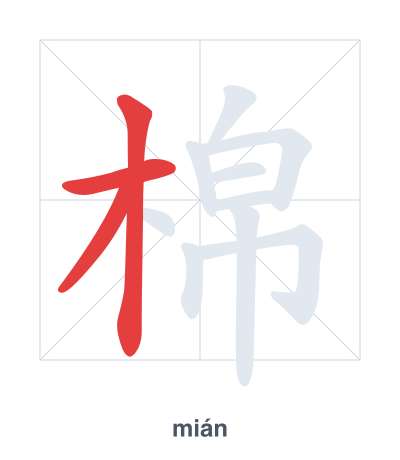
Open Hanzi Writer to see the animated stroke order and practice writing 棉 with real-time feedback.
The character 棉 (mián) is written with 12 strokes. Follow the standard Chinese stroke order: top to bottom, left to right, outside before inside. The radical 木 is one of its key components.
Practice the correct stroke order with the Hanzi Writer app to see animated stroke-by-stroke guidance with real-time feedback.
棉 means cotton.
As an HSK Level 6 character, 棉 is an intermediate-level character.
棉 is a compound character combining the radical 木 (tree/wood) with 帛 (silk cloth). The wood radical indicates cotton is a plant, while 帛 (silk) suggests the soft, fibrous material it produces—like a tree yielding silky fibers.
💡 Memory Tip: Picture a tree (木) wearing a fluffy white cloth (帛) that is actually cotton ready to harvest.
地里长满了棉花。
dì lǐ zhǎng mǎn le mián huā
The field is full of cotton.
冬天要穿棉衣。
dōng tiān yào chuān mián yī
One needs to wear cotton-padded clothes in winter.
这床棉被很暖和。
zhè chuáng mián bèi hěn nuǎn huo
This cotton quilt is very warm.
Open Hanzi Writer to see the animated stroke order and practice writing 棉 with real-time feedback.
✨ Animated stroke order · Handwriting recognition · HSK-graded practice · Free to use
棉 combines the radical 木 (wood/tree) on the left and 帛 (silk/fabric) on the right. Together, they suggest a plant (木) that produces fiber used for cloth (帛), which is exactly what cotton is.