栖 (qī/xī) means "To perch / To dwell" in Chinese. It has 10 strokes with the radical 木, and is HSK Level 7.
Rated 4.2/5 in difficulty (advanced).
Harder than 63% of HSK Level 7 characters.
Appears in 3+ common words including 栖息 (qī xī), 栖身 (qī shēn), 栖栖 (xī xī).
Due to its 10 strokes, Hanzi Writer's error detection shows 栖 requires focused practice — most learners need 10+ attempts for consistent accuracy.
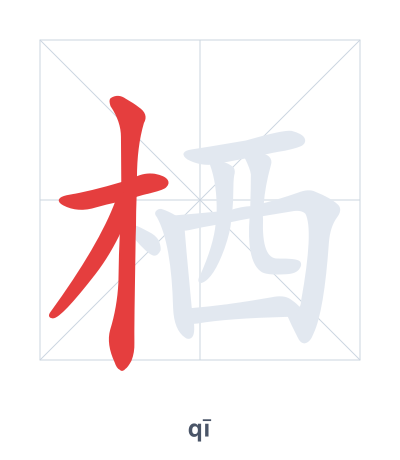
Open Hanzi Writer to see the animated stroke order and practice writing 栖 with real-time feedback.
The character 栖 (qī/xī) is written with 10 strokes. Follow the standard Chinese stroke order: top to bottom, left to right, outside before inside. The radical 木 is one of its key components.
Practice the correct stroke order with the Hanzi Writer app to see animated stroke-by-stroke guidance with real-time feedback.
栖 means To perch / To dwell.
This is a polyphonic character with readings: qī, xī.
As an HSK Level 7 character, 栖 is an intermediate-level character.
栖 combines the tree radical 木 with 西 (west), which also hints at the sound qī. The character originally depicted a bird perching on a tree, as birds often settle in trees toward the west at sunset. Thus, the visual of a tree and the western direction evokes the idea of perching or dwelling.
💡 Memory Tip: Picture a bird flying west to perch on a tree (木) just as the sun sets, finding a cozy spot to dwell for the night.
这片茂密的森林是许多珍稀鸟类的栖息地。
zhè piàn mào mì de sēn lín shì xǔ duō zhēn xī niǎo lèi de qī xī dì
This dense forest is a habitat for many rare birds.
这里是他多年来唯一的栖身之所。
zhè lǐ shì tā duō nián lái wéi yī de qī shēn zhī suǒ
This has been his only shelter for many years.
他整天奔波在外,过着这种栖栖不安的生活。
tā zhěng tiān bēn bō zài wài guò zhe zhè zhǒng xī xī bù ān de shēng huó
He is on the move all day, living a restless and unsettled life.
Open Hanzi Writer to see the animated stroke order and practice writing 栖 with real-time feedback.
✨ Animated stroke order · Handwriting recognition · HSK-graded practice · Free to use
The character 栖 is made of the radical 木 (tree) on the left and 西 (west) on the right. The tree radical shows the meaning relates to trees or wood, which makes sense because birds perch on trees. The right side 西 gives pronunciation (qī) and can hint at a location (west) where one might dwell.