菀 (wǎn) means "Luxuriant / Lush" in Chinese. It has 11 strokes with the radical 艹.
Rated 4.2/5 in difficulty (advanced).
Appears in 3+ common words including 菀菀 (wǎn wǎn), 枯菀 (kū wǎn), 菀柳 (wǎn liǔ).
Due to its 11 strokes, Hanzi Writer's error detection shows 菀 requires focused practice — most learners need 10+ attempts for consistent accuracy.
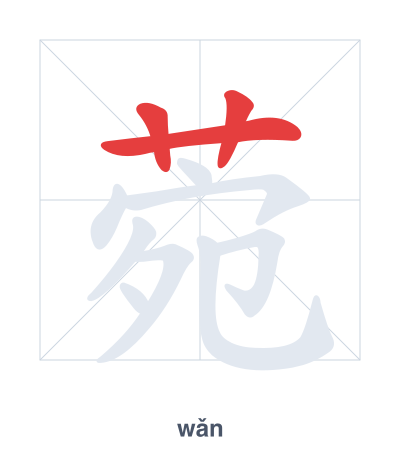
Open Hanzi Writer to see the animated stroke order and practice writing 菀 with real-time feedback.
The character 菀 (wǎn) is written with 11 strokes. Follow the standard Chinese stroke order: top to bottom, left to right, outside before inside. The radical 艹 is one of its key components.
Practice the correct stroke order with the Hanzi Writer app to see animated stroke-by-stroke guidance with real-time feedback.
菀 means Luxuriant / Lush.
菀 is a phono-semantic compound: the radical 艹 (grass) indicates it relates to plants, while the phonetic component 宛 (wǎn, meaning 'winding' or 'bending') also suggests how lush, dense grass twists and curls as it grows luxuriantly.
💡 Memory Tip: Picture a patch of grass (艹) growing so lush that it forms a winding, tangled maze (宛) you could get lost in.
草木长得菀菀的。
cǎo mù zhǎng dé wǎn wǎn de
The plants are growing luxuriantly.
草木有枯也有菀。
cǎo mù yǒu kū yě yǒu wǎn
Plants wither and also flourish.
河边有一棵菀柳。
hé biān yǒu yī kē wǎn liǔ
There is a lush willow tree by the river.
Open Hanzi Writer to see the animated stroke order and practice writing 菀 with real-time feedback.
✨ Animated stroke order · Handwriting recognition · HSK-graded practice · Free to use
The character combines the radical 艹 (grass) on top, hinting at plants or vegetation, with the phonetic component 宛 (wǎn, meaning 'winding' or 'like'). Together, they evoke the image of grass that grows thick and lush, like a winding field of vegetation.