莿 (cì) means "Thorn / Prickle" in Chinese. It has 12 strokes with the radical 艹.
Rated 4.2/5 in difficulty (advanced).
Appears in 3+ common words including 莿桐 (cì tóng), 莿草 (cì cǎo), 莿丛 (cì cóng).
Due to its 12 strokes, Hanzi Writer's error detection shows 莿 requires focused practice — most learners need 10+ attempts for consistent accuracy.
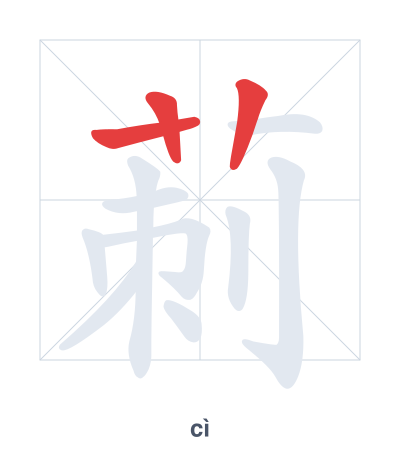
Open Hanzi Writer to see the animated stroke order and practice writing 莿 with real-time feedback.
The character 莿 (cì) is written with 12 strokes. Follow the standard Chinese stroke order: top to bottom, left to right, outside before inside. The radical 艹 is one of its key components.
Practice the correct stroke order with the Hanzi Writer app to see animated stroke-by-stroke guidance with real-time feedback.
莿 means Thorn / Prickle.
莿 is a compound character: the top radical 艹 (grass) indicates a plant, while the lower component 剌 (a character combining 束 'bundle' and 刂 'knife') suggests piercing or cutting—together they depict a thorny plant with sharp, pricking parts.
💡 Memory Tip: Imagine a grass plant (艹) where a bundle of tiny knives (剌) sticks out from each stem—that's a painful thorn!
莿桐花在春天开放。
cì tóng huā zài chūn tiān kāi fàng
Tiger's claw flowers bloom in spring.
路边有很多莿草。
lù biān yǒu hěn duō cì cǎo
There are many thorny weeds by the roadside.
小猫躲在莿丛里。
xiǎo māo duǒ zài cì cóng lǐ
The kitten is hiding in the thorns.
Open Hanzi Writer to see the animated stroke order and practice writing 莿 with real-time feedback.
✨ Animated stroke order · Handwriting recognition · HSK-graded practice · Free to use
莿 is composed of the grass radical 艹 on top and the phonetic component 刺 (cì, which also means thorn) below. The grass radical indicates the character is related to plants, while the lower part provides both sound and meaning, together forming the idea of a thorny plant or prickle.