瞎 (xiā) means "Blind" in Chinese. It has 15 strokes with the radical 目, and is HSK Level 7.
Rated 4.2/5 in difficulty (advanced).
Harder than 74% of HSK Level 7 characters.
Appears in 3+ common words including 瞎说 (xiā shuō), 瞎闹 (xiā nào), 瞎子 (xiā zi).
Due to its 15 strokes, Hanzi Writer's error detection shows 瞎 requires focused practice — most learners need 10+ attempts for consistent accuracy.
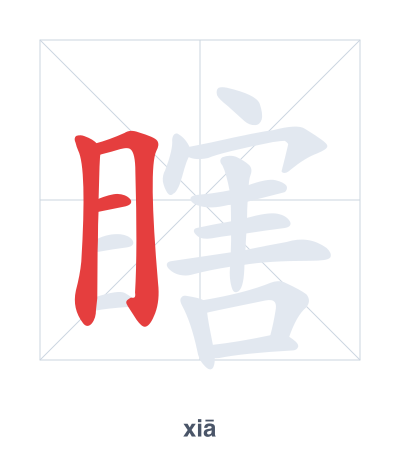
Open Hanzi Writer to see the animated stroke order and practice writing 瞎 with real-time feedback.
The character 瞎 (xiā) is written with 15 strokes. Follow the standard Chinese stroke order: top to bottom, left to right, outside before inside. The radical 目 is one of its key components.
Practice the correct stroke order with the Hanzi Writer app to see animated stroke-by-stroke guidance with real-time feedback.
瞎 means Blind.
As an HSK Level 7 character, 瞎 is an intermediate-level character.
瞎 combines the eye radical (目) with 害 (harm), literally meaning 'eye harmed'—a damaged eye that cannot see.
💡 Memory Tip: Picture a harmful needle (害) poking an eye (目), making it blind.
你不要瞎说。
nǐ bú yào xiā shuō
Don't talk nonsense.
别在这里瞎闹。
bié zài zhè lǐ xiā nào
Don't mess around here.
瞎子在过马路。
xiā zi zài guò mǎ lù
A blind person is crossing the road.
Open Hanzi Writer to see the animated stroke order and practice writing 瞎 with real-time feedback.
✨ Animated stroke order · Handwriting recognition · HSK-graded practice · Free to use
瞎 combines the radical 目 (eye) on the left and the phonetic component 害 (hài, meaning 'harm') on the right. The eye radical hints at the meaning "blind," while 害 suggests that the blindness is a harmful condition. Together, the character visually represents an eye that is damaged or harmed.