媚 (mèi) means "Charming; to fawn on; to flatter." in Chinese. It has 12 strokes with the radical 女, and is HSK Level 7.
Rated 4.2/5 in difficulty (advanced).
Harder than 51% of HSK Level 7 characters.
Appears in 3+ common words including 明媚 (míng mèi), 妩媚 (wǔ mèi), 谄媚 (chǎn mèi).
Due to its 12 strokes, Hanzi Writer's error detection shows 媚 requires focused practice — most learners need 10+ attempts for consistent accuracy.
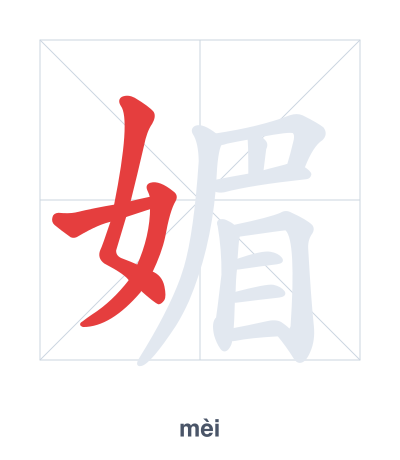
Open Hanzi Writer to see the animated stroke order and practice writing 媚 with real-time feedback.
The character 媚 (mèi) is written with 12 strokes. Follow the standard Chinese stroke order: top to bottom, left to right, outside before inside. The radical 女 is one of its key components.
Practice the correct stroke order with the Hanzi Writer app to see animated stroke-by-stroke guidance with real-time feedback.
媚 means Charming; to fawn on; to flatter..
As an HSK Level 7 character, 媚 is an intermediate-level character.
媚 combines the radical 女 (woman) with 眉 (eyebrow), suggesting a woman using her eyebrows — traditionally a feature of allure — to charm or flatter. The eyebrow component 眉 also contributes phonetic value (mèi).
💡 Memory Tip: Imagine a woman (女) raising her elegant eyebrow (眉) to give a flattering, charming smile.
阳光非常明媚。
yáng guāng fēi cháng míng mèi
The sunlight is very radiant and beautiful.
她笑得很妩媚。
tā xiào dé hěn wǔ mèi
She smiles very charmingly.
他在向老板谄媚。
tā zài xiàng lǎo bǎn chǎn mèi
He is flattering his boss.
Open Hanzi Writer to see the animated stroke order and practice writing 媚 with real-time feedback.
✨ Animated stroke order · Handwriting recognition · HSK-graded practice · Free to use
媚 is made of the radical 女 (woman) on the left and 眉 (eyebrow) on the right. The woman radical hints at feminine qualities, while the eyebrow component suggests facial beauty, together conveying charm or flattery.