娌 (lǐ) means "sister-in-law" in Chinese. It has 10 strokes with the radical 女.
Rated 4.2/5 in difficulty (advanced).
Appears in 3+ common words including 妯娌 (zhóu lǐ), 娌娌 (lǐ lǐ), 大娌 (dà lǐ).
Due to its 10 strokes, Hanzi Writer's error detection shows 娌 requires focused practice — most learners need 10+ attempts for consistent accuracy.
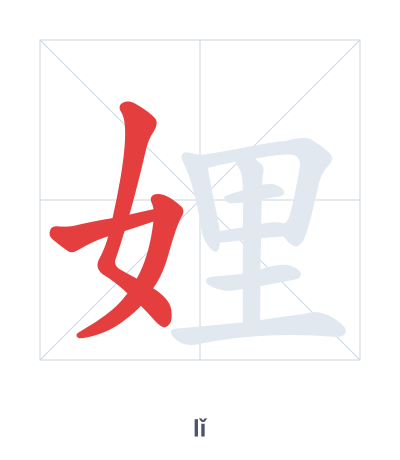
Open Hanzi Writer to see the animated stroke order and practice writing 娌 with real-time feedback.
The character 娌 (lǐ) is written with 10 strokes. Follow the standard Chinese stroke order: top to bottom, left to right, outside before inside. The radical 女 is one of its key components.
Practice the correct stroke order with the Hanzi Writer app to see animated stroke-by-stroke guidance with real-time feedback.
娌 means sister-in-law.
娌 is a phono-semantic compound where the radical 女 (woman) indicates the meaning relates to female family relations, and 里 (lǐ, meaning 'inside' or 'village') provides the pronunciation. The character specifically denotes a sister-in-law, typically the wife of one's elder brother—a woman who marries into the household and becomes part of the inner family circle.
💡 Memory Tip: Imagine a woman (女) inside a house or village (里) who is your brother's wife, so she's your sister-in-law.
她们是好妯娌。
tā men shì hǎo zhóu lǐ
They are good sisters-in-law (wives of brothers).
妯娌之间要和睦。
zhóu lǐ zhī jiān yào hé mù
Sisters-in-law should live in harmony.
她是我的大娌。
tā shì wǒ de dà lǐ
She is my eldest sister-in-law.
Open Hanzi Writer to see the animated stroke order and practice writing 娌 with real-time feedback.
✨ Animated stroke order · Handwriting recognition · HSK-graded practice · Free to use
娌 is made of the radical 女 (woman) on the left and 里 (inside or village) on the right. The radical shows that the character relates to a woman, while 里 hints at the family setting because a sister-in-law is a female family member who lives with the household.