谄 (chǎn) means "To flatter; to fawn" in Chinese. It has 10 strokes with the radical 讠.
Rated 3.9/5 in difficulty (challenging).
Appears in 3+ common words including 谄媚 (chǎn mèi), 谄笑 (chǎn xiào), 贫而无谄 (pín ér wú chǎn).
Due to its 10 strokes, Hanzi Writer's error detection shows 谄 requires focused practice — most learners need 10+ attempts for consistent accuracy.
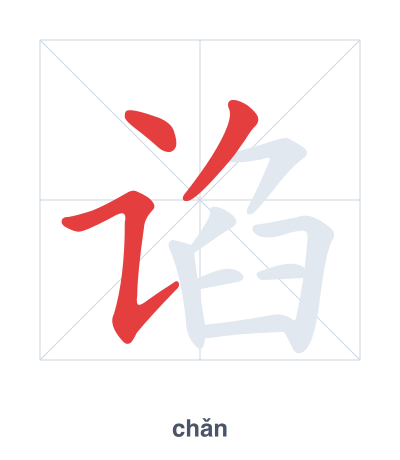
Open Hanzi Writer to see the animated stroke order and practice writing 谄 with real-time feedback.
The character 谄 (chǎn) is written with 10 strokes. Follow the standard Chinese stroke order: top to bottom, left to right, outside before inside. The radical 讠 is one of its key components.
Practice the correct stroke order with the Hanzi Writer app to see animated stroke-by-stroke guidance with real-time feedback.
谄 means To flatter; to fawn.
谄 combines the radical 讠 (speech) with 臽 (a pit trap), suggesting words that lead someone into a trap. The right side originally depicted a person falling into a pit, so flattering speech is like a verbal trap to gain favor.
💡 Memory Tip: Imagine a flatterer (讠) digging a pit (臽) with sweet words to catch you.
他不向任何人谄媚。
tā bù xiàng rèn hé rén chǎn mèi
He doesn't flatter anyone.
那个人露出了谄笑。
nà ge rén lù chū le chǎn xiào
That person gave a fawning smile.
做人应当贫而无谄。
zuò rén yīng dāng pín ér wú chǎn
One should be poor but not fawning.
Open Hanzi Writer to see the animated stroke order and practice writing 谄 with real-time feedback.
✨ Animated stroke order · Handwriting recognition · HSK-graded practice · Free to use
The left radical 讠 means speech or words, which shows that flattering is done through speaking. The right component 臽 provides the pronunciation and also hints at the idea of 'falling into a trap' or lowering oneself, suggesting flattery is a form of self-debasement. Together, the character depicts the act of using words to lower yourself in order to please someone.