姬 (jī) means "concubine; lady; surname Ji" in Chinese. It has 10 strokes with the radical 女.
Rated 4.2/5 in difficulty (advanced).
Appears in 3+ common words including 歌姬 (gē jī), 虞姬 (yú jī), 姬姓 (jī xìng).
Due to its 10 strokes, Hanzi Writer's error detection shows 姬 requires focused practice — most learners need 10+ attempts for consistent accuracy.
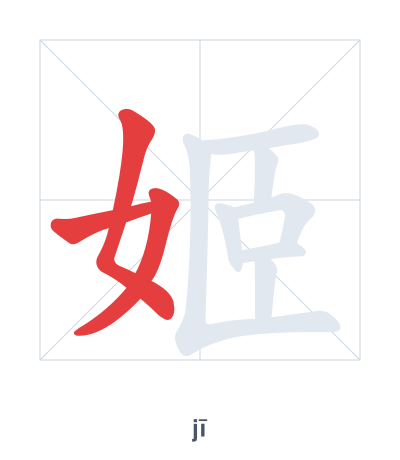
Open Hanzi Writer to see the animated stroke order and practice writing 姬 with real-time feedback.
The character 姬 (jī) is written with 10 strokes. Follow the standard Chinese stroke order: top to bottom, left to right, outside before inside. The radical 女 is one of its key components.
Practice the correct stroke order with the Hanzi Writer app to see animated stroke-by-stroke guidance with real-time feedback.
姬 means concubine; lady; surname Ji.
姬 combines the radical 女 (woman) with a component resembling 臣 (minister) and 口 (mouth), indicating a woman of high status. It originally referred to the Zhou royal surname, and later came to mean a noble lady or concubine.
💡 Memory Tip: Imagine a woman (女) standing before a minister (臣) who opens his mouth (口) to announce her as a royal lady—姬.
这位歌姬唱歌很好听。
zhè wèi gē jī chàng gē hěn hǎo tīng
This songstress sings very beautifully.
虞姬是古代的美女。
yú jī shì gǔ dài de měi nǚ
Consort Yu was a beauty of ancient times.
姬姓是古老的姓氏。
jī xìng shì gǔ lǎo de xìng shì
The Ji surname is an ancient family name.
Open Hanzi Writer to see the animated stroke order and practice writing 姬 with real-time feedback.
✨ Animated stroke order · Handwriting recognition · HSK-graded practice · Free to use
The character 姬 combines the radical 女 (woman) on the left with 臣 (minister/official) on the right, though the right side is actually a phonetic component derived from 颐 (chin/cheek). Together, the 女 radical gives it a feminine association, fitting its historical meanings related to women of high status or performers.