Hanzi Writer

How to Write 梅 (méi) — Meaning “Plum”

méi HSK Level 6 11 strokes Radical: 木

梅 (méi) means "Plum" in Chinese. It has 11 strokes with the radical 木, and is HSK Level 6.

Rated 4.2/5 in difficulty (advanced).

Harder than 69% of HSK Level 6 characters.

Appears in 3+ common words including 梅花 (méi huā), 腊梅 (là méi), 杨梅 (yáng méi).

Due to its 11 strokes, Hanzi Writer's error detection shows 梅 requires focused practice — most learners need 10+ attempts for consistent accuracy.
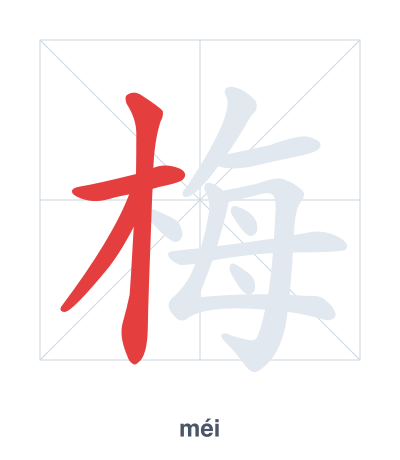
Stroke order practice for 梅 - méi

Practice Writing 梅 (méi)

Open Hanzi Writer to see the animated stroke order and practice writing 梅 with real-time feedback.

The character (méi) is written with 11 strokes. Follow the standard Chinese stroke order: top to bottom, left to right, outside before inside. The radical is one of its key components.

Practice the correct stroke order with the Hanzi Writer app to see animated stroke-by-stroke guidance with real-time feedback.

means Plum.

As an HSK Level 6 character, is an intermediate-level character.

Character
Pinyinméi (mei)
MeaningPlum
Strokes11
Radical
HSK Level6
Difficulty4.2/5

梅 combines the tree radical 木 with the phonetic component 每 (měi, meaning 'every' or 'each'), originally depicting a plum tree. The ancient form shows a tree with fruit, and the modern structure uses 每 to suggest pronunciation while 木 provides the tree meaning.

💡 Memory Tip: Every (每) tree (木) bears sweet plums in winter.

méi huā
Plum blossom
là méi
Wintersweet
yáng méi
waxberry; bayberry

梅花在冬天开放。

méi huā zài dōng tiān kāi fàng

Plum blossoms bloom in winter.

腊梅的味道很香。

là méi de wèi dào hěn xiāng

Wintersweet has a very fragrant scent.

我喜欢吃杨梅。

wǒ xǐ huān chī yáng méi

I like eating waxberries.

Character Pinyin Strokes Radical
(current) méi 11
9
píng 9
zhǐ 9
Stroke order practice for 梅 - méi

Practice Writing 梅 (méi)

Open Hanzi Writer to see the animated stroke order and practice writing 梅 with real-time feedback.

✨ Animated stroke order · Handwriting recognition · HSK-graded practice · Free to use

Frequently Asked Questions about 梅

梅 is made of the radical 木 (wood/tree) on the left, which indicates it relates to trees, and the phonetic component 每 on the right, which hints at the pronunciation 'méi'. Together, they form the character for the plum tree, a type of fruit tree.

More HSK Level 6 Characters

Characters with Radical 木

Other 11-Stroke Characters