馒 (mán) means "steamed bun" in Chinese. It has 14 strokes with the radical 饣, and is HSK Level 6.
Rated 4.2/5 in difficulty (advanced).
Harder than 100% of HSK Level 6 characters.
Appears in 3+ common words including 馒头 (mán tou), 蒸馒头 (zhēng mán tou), 小馒头 (xiǎo mán tou).
Due to its 14 strokes, Hanzi Writer's error detection shows 馒 requires focused practice — most learners need 10+ attempts for consistent accuracy.
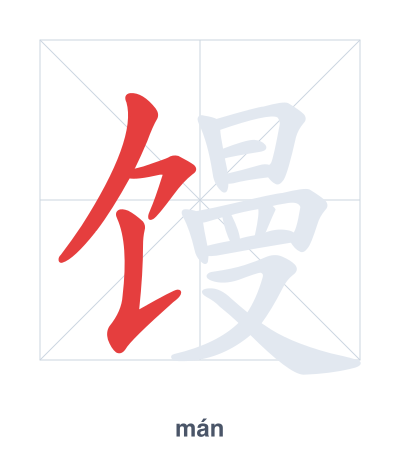
Open Hanzi Writer to see the animated stroke order and practice writing 馒 with real-time feedback.
The character 馒 (mán) is written with 14 strokes. Follow the standard Chinese stroke order: top to bottom, left to right, outside before inside. The radical 饣 is one of its key components.
Practice the correct stroke order with the Hanzi Writer app to see animated stroke-by-stroke guidance with real-time feedback.
馒 means steamed bun.
As an HSK Level 6 character, 馒 is an intermediate-level character.
馒 is a semantic-phonetic compound. The radical 饣 (food) hints at its edible nature, while 曼 (màn, meaning 'to spread' or 'prolonged') provides the pronunciation. The character was created to represent a type of steamed bread that is often soft and spread in shape.
💡 Memory Tip: Picture a steamed bun (饣) that is so big it spreads out like 曼, covering the whole plate.
我早餐吃馒头。
wǒ zǎo cān chī mán tou
I eat steamed buns for breakfast.
奶奶在蒸馒头。
nǎi nǎi zài zhēng mán tou
Grandma is steaming buns.
这个小馒头很香。
zhè ge xiǎo mán tou hěn xiāng
This small steamed bun is delicious.
Open Hanzi Writer to see the animated stroke order and practice writing 馒 with real-time feedback.
✨ Animated stroke order · Handwriting recognition · HSK-graded practice · Free to use
The left radical 饣 (food/eat) shows this character relates to food. The right part 曼 (màn) contributes sound and loosely suggests a soft texture, as steamed buns are pillowy. Together, the components mean a food item called steamed bun.