饨 (tún) means "wonton" in Chinese. It has 7 strokes with the radical 饣.
Rated 3.5/5 in difficulty (challenging).
Appears in 3+ common words including 馄饨 (hún tún), 馄饨面 (hún tún miàn), 煮馄饨 (zhǔ hún tún).
Due to its 7 strokes, Hanzi Writer's error detection shows 饨 requires focused practice — most learners need 10+ attempts for consistent accuracy.
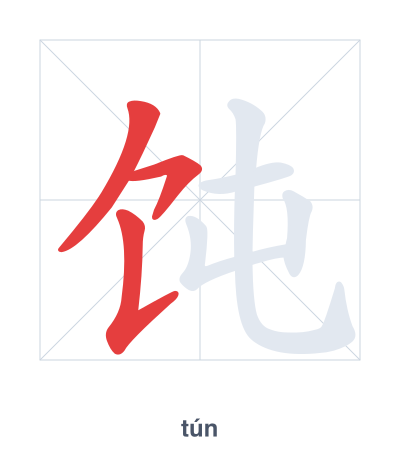
Open Hanzi Writer to see the animated stroke order and practice writing 饨 with real-time feedback.
The character 饨 (tún) is written with 7 strokes. Follow the standard Chinese stroke order: top to bottom, left to right, outside before inside. The radical 饣 is one of its key components.
Practice the correct stroke order with the Hanzi Writer app to see animated stroke-by-stroke guidance with real-time feedback.
饨 means wonton.
饨 is a semantic-phonetic compound: the radical 饣 (food) indicates it relates to edible items, while the phonetic component 屯 (tún) suggests wrapping or gathering, as wontons are wrapped fillings. Together, 饨 originally meant a kind of stuffed dumpling, now specifically wonton.
💡 Memory Tip: Picture a wonton (饣) wrapped tightly like a bundle (屯) ready to be boiled.
我想吃一碗馄饨。
wǒ xiǎng chī yī wǎn hún tún
I want to eat a bowl of wontons.
这家馄饨面很有名。
zhè jiā hún tún miàn hěn yǒu míng
This wonton noodle shop is very famous.
妈妈在厨房煮馄饨。
mā mā zài chú fáng zhǔ hún tún
Mom is boiling wontons in the kitchen.
Open Hanzi Writer to see the animated stroke order and practice writing 饨 with real-time feedback.
✨ Animated stroke order · Handwriting recognition · HSK-graded practice · Free to use
饨 is made of the radical 饣 (food) on the left and 屯 (tún, meaning "to store" or "village") on the right. The food radical indicates it relates to eating, and the 屯 part hints at the sound (tún). Together they form the character for wonton, a kind of filled dumpling.