馇 (chā) means "To cook (porridge) / corn noodles" in Chinese. It has 12 strokes with the radical 饣.
Rated 4.2/5 in difficulty (advanced).
Appears in 3+ common words including 馇子 (chā zi), 馇粥 (chā zhōu), 馇豆腐 (chā dòu fǔ).
Due to its 12 strokes, Hanzi Writer's error detection shows 馇 requires focused practice — most learners need 10+ attempts for consistent accuracy.
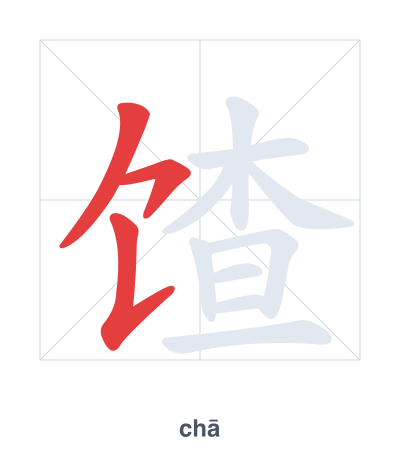
Open Hanzi Writer to see the animated stroke order and practice writing 馇 with real-time feedback.
The character 馇 (chā) is written with 12 strokes. Follow the standard Chinese stroke order: top to bottom, left to right, outside before inside. The radical 饣 is one of its key components.
Practice the correct stroke order with the Hanzi Writer app to see animated stroke-by-stroke guidance with real-time feedback.
馇 means To cook (porridge) / corn noodles.
馇 is a compound character with the food radical 饣 (meaning 'eat' or 'food') on the left, and 查 (meaning 'examine' or 'check') on the right, which serves as a phonetic component. Together, they suggest the careful stirring and checking involved in cooking thick porridge or corn noodles, a process that requires constant attention to avoid burning or lumping.
💡 Memory Tip: Picture a chef (饣) using a wooden spoon (木 from 查) to stir a pot of porridge at dawn (旦 from 查), checking (查) the consistency as it cooks.
这种馇子很好吃。
zhè zhǒng chā zi hěn hǎo chī
This kind of corn noodles is delicious.
奶奶在做馇粥。
nǎi nǎi zài zuò chā zhōu
Grandma is making corn porridge.
他喜欢吃馇豆腐。
tā xǐ huān chī chā dòu fǔ
He likes eating Cha tofu.
Open Hanzi Writer to see the animated stroke order and practice writing 馇 with real-time feedback.
✨ Animated stroke order · Handwriting recognition · HSK-graded practice · Free to use
馇 is made of the radical 饣 (food or eat) on the left and 查 (chá, to check or investigate) on the right. The left part connects it to cooking or food, while the right part 查 gives the pronunciation chā. Together, the character means to cook things like porridge or stew.