饥 (jī) means "hunger; famine" in Chinese. It has 5 strokes with the radical 饣, and is HSK Level 7.
Rated 2.9/5 in difficulty (moderate).
Harder than 8% of HSK Level 7 characters.
Appears in 3+ common words including 饥饿 (jī è), 饥渴 (jī kě), 饥荒 (jī huāng).
Hanzi Writer's stroke validation shows learners typically need 5-8 attempts to write 饥 with correct proportion and order.
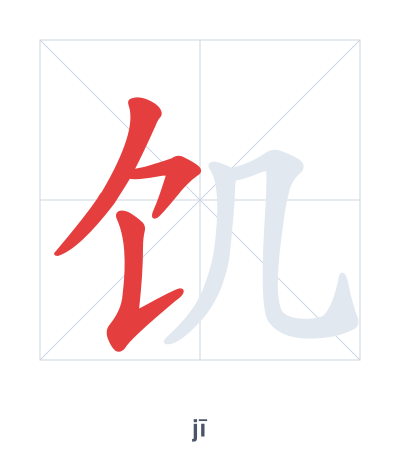
Open Hanzi Writer to see the animated stroke order and practice writing 饥 with real-time feedback.
The character 饥 (jī) is written with 5 strokes. Follow the standard Chinese stroke order: top to bottom, left to right, outside before inside. The radical 饣 is one of its key components.
Practice the correct stroke order with the Hanzi Writer app to see animated stroke-by-stroke guidance with real-time feedback.
饥 means hunger; famine.
As an HSK Level 7 character, 饥 is an intermediate-level character.
饥 is a phono-semantic compound. The left part 饣 (food radical) indicates the meaning relates to food or eating, while the right part 几 (jǐ) provides the pronunciation. Together, the character conveys a lack of food, leading to hunger or famine.
💡 Memory Tip: Imagine a starving person counting how many (几) bites of food (饣) they have left — almost none.
他感到非常饥饿。
tā gǎn dào fēi cháng jī è
He feels very hungry.
知识的饥渴很重要。
zhī shí de jī kě hěn zhòng yào
A thirst for knowledge is very important.
那里发生了饥荒。
nà lǐ fā shēng le jī huāng
A famine occurred there.
Open Hanzi Writer to see the animated stroke order and practice writing 饥 with real-time feedback.
✨ Animated stroke order · Handwriting recognition · HSK-graded practice · Free to use
The character 饥 is a phono-semantic compound. The left radical 饣 (food) suggests the meaning relates to food, while the right part 几 provides a phonetic hint for the pronunciation jī. Together, the character conveys the idea of lacking food, leading to hunger or famine.