饫 (yù) means "to be satiated; to be full" in Chinese. It has 7 strokes with the radical 饣.
Rated 3.5/5 in difficulty (challenging).
Appears in 3+ common words including 饫闻 (yù wén), 饱饫 (bǎo yù), 饫肥 (yù féi).
Due to its 7 strokes, Hanzi Writer's error detection shows 饫 requires focused practice — most learners need 10+ attempts for consistent accuracy.
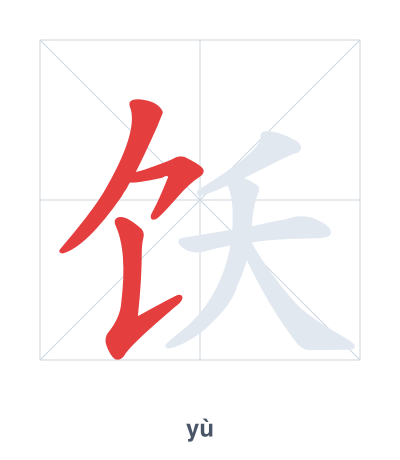
Open Hanzi Writer to see the animated stroke order and practice writing 饫 with real-time feedback.
The character 饫 (yù) is written with 7 strokes. Follow the standard Chinese stroke order: top to bottom, left to right, outside before inside. The radical 饣 is one of its key components.
Practice the correct stroke order with the Hanzi Writer app to see animated stroke-by-stroke guidance with real-time feedback.
饫 means to be satiated; to be full.
饫 is a phono-semantic compound: the left radical 饣 (food) indicates it relates to eating, and the right component 夭 (yāo) provides the sound. The meaning 'to be satiated' derives from being fully satisfied after eating.
💡 Memory Tip: Picture a person (夭) after devouring a feast (饣) lying on their back, patting a huge belly, utterly stuffed.
这件事早已饫闻。
zhè jiàn shì zǎo yǐ yù wén
I have long heard of this matter.
饱饫经书。
bǎo yù jīng shū
To be well-versed in the classics.
饫甘餍肥的生活。
yù gān yàn féi de shēng huó
A life of luxury and fine dining.
Open Hanzi Writer to see the animated stroke order and practice writing 饫 with real-time feedback.
✨ Animated stroke order · Handwriting recognition · HSK-graded practice · Free to use
饫 is composed of the food radical 饣 on the left and the phonetic component 夭 on the right. The radical hints that the meaning involves eating, while 夭 provides the pronunciation yù. Together they create the idea of eating until one is full or satiated.