餍 (yàn) means "to eat one's fill; to be satisfied" in Chinese. It has 15 strokes with the radical 饣.
Rated 4.2/5 in difficulty (advanced).
Appears in 3+ common words including 餍足 (yàn zú), 贪得无餍 (tān dé wú yàn), 饱餍 (bǎo yàn).
Due to its 15 strokes, Hanzi Writer's error detection shows 餍 requires focused practice — most learners need 10+ attempts for consistent accuracy.
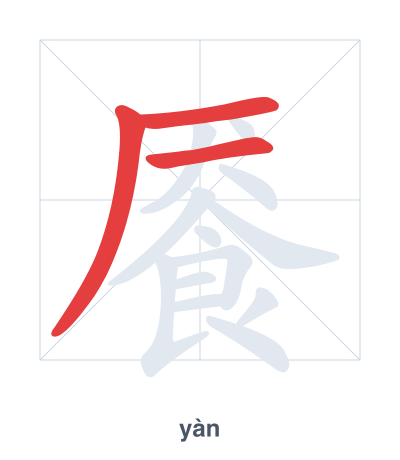
Open Hanzi Writer to see the animated stroke order and practice writing 餍 with real-time feedback.
The character 餍 (yàn) is written with 15 strokes. Follow the standard Chinese stroke order: top to bottom, left to right, outside before inside. The radical 饣 is one of its key components.
Practice the correct stroke order with the Hanzi Writer app to see animated stroke-by-stroke guidance with real-time feedback.
餍 means to eat one's fill; to be satisfied.
餍 combines the food radical 饣 (short for 食) with 厌 (yàn), which provides the sound and also conveys the sense of 'being pressed' (from a dog under a cliff) — here indicating hunger being pressed down until fully satisfied. The structure thus shows eating until one's appetite is completely filled.
💡 Memory Tip: Picture a greedy dog (犬) under a cliff (厂) gorging itself on food (饣) until it lies back completely satisfied.
他感到非常餍足。
tā gǎn dào fēi cháng yàn zú
He feels very satisfied.
这种人总是贪得无餍。
zhè zhǒng rén zǒng shì tān dé wú yàn
This kind of person is always insatiably greedy.
我们饱餍了一顿大餐。
wǒ men bǎo yàn le yī dùn dà cān
We feasted on a big meal.
Open Hanzi Writer to see the animated stroke order and practice writing 餍 with real-time feedback.
✨ Animated stroke order · Handwriting recognition · HSK-graded practice · Free to use
餍 consists of the radical 饣 (food) on the left and the character 厌 (yàn) on the right. The left part suggests eating, while the right part 厌 historically carried the sense of being full or satiated. Together, they convey the idea of eating until one is satisfied or fully filled.