埋 (mái/mán) means "to bury" in Chinese. It has 10 strokes with the radical 土, and is HSK Level 6.
Rated 4.2/5 in difficulty (advanced).
Harder than 55% of HSK Level 6 characters.
Appears in 3+ common words including 埋伏 (mái fú), 埋藏 (mái cáng), 埋怨 (mán yuàn).
Due to its 10 strokes, Hanzi Writer's error detection shows 埋 requires focused practice — most learners need 10+ attempts for consistent accuracy.
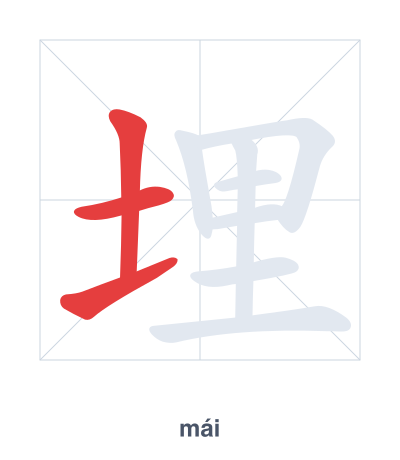
Open Hanzi Writer to see the animated stroke order and practice writing 埋 with real-time feedback.
The character 埋 (mái/mán) is written with 10 strokes. Follow the standard Chinese stroke order: top to bottom, left to right, outside before inside. The radical 土 is one of its key components.
Practice the correct stroke order with the Hanzi Writer app to see animated stroke-by-stroke guidance with real-time feedback.
埋 means to bury.
This is a polyphonic character with readings: mái, mán.
As an HSK Level 6 character, 埋 is an intermediate-level character.
埋 is a phono-semantic compound. The left side 土 (earth, soil) indicates burying involves the ground, while the right side 里 (lǐ, inside/village) provides the sound and also suggests something placed inside the earth. Together, they evoke the act of putting something into the soil to be covered.
💡 Memory Tip: Imagine piling dirt (土) over a tiny buried village (里) to hide it underground.
游击队员在狭窄的山谷里设下了埋伏。
yóu jī duì yuán zài xiá zhǎi de shān gǔ lǐ shè xià le mái fú
Guerrillas set up an ambush in the narrow valley.
这里的地下埋藏着丰富的煤炭和石油。
zhè lǐ de dì xià mái cáng zhe fēng fù de méi tàn hé shí yóu
Rich coal and oil are buried underground here.
我们要多找自己的原因,不要总是埋怨别人。
wǒ men yào duō zhǎo zì jǐ de yuán yīn bú yào zǒng shì mán yuàn bié rén
We should look more for our own faults and not always blame others.
Open Hanzi Writer to see the animated stroke order and practice writing 埋 with real-time feedback.
✨ Animated stroke order · Handwriting recognition · HSK-graded practice · Free to use
埋 is composed of the radical 土 (earth) on the left and 里 (inside) on the right. The earth radical suggests burying something in the ground, while 里 indicates the location inside or beneath. Together, they create the image of putting something into the earth, which is the core meaning of to bury.