伏 (fú) means "To lean over; to hide; to yield; dog days of summer" in Chinese. It has 6 strokes with the radical 亻, and is HSK Level 7.
Rated 2.9/5 in difficulty (moderate).
Harder than 5% of HSK Level 7 characters.
Appears in 3+ common words including 伏案 (fú àn), 起伏 (qǐ fú), 埋伏 (mái fú).
Hanzi Writer's stroke validation shows learners typically need 5-8 attempts to write 伏 with correct proportion and order.
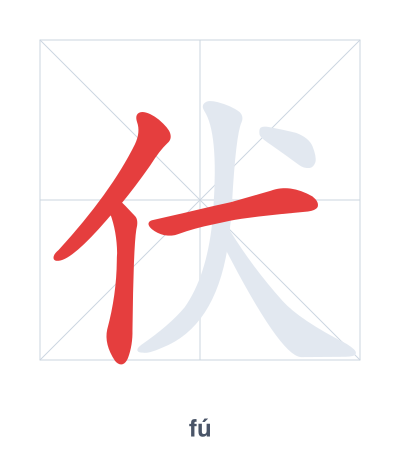
Open Hanzi Writer to see the animated stroke order and practice writing 伏 with real-time feedback.
The character 伏 (fú) is written with 6 strokes. Follow the standard Chinese stroke order: top to bottom, left to right, outside before inside. The radical 亻 is one of its key components.
Practice the correct stroke order with the Hanzi Writer app to see animated stroke-by-stroke guidance with real-time feedback.
伏 means To lean over; to hide; to yield; dog days of summer.
As an HSK Level 7 character, 伏 is an intermediate-level character.
伏 combines the radical 亻 (person) and 犬 (dog), originally showing a person crouching or lying low like a dog. This image conveys meanings of leaning over, hiding, or yielding, and later extended to the dog days of summer when dogs lie flat in the heat.
💡 Memory Tip: Picture a person (亻) lying down like a dog (犬) on a scorching summer day, hiding from the sun.
他在伏案写作。
tā zài fú àn xiě zuò
He is writing at his desk.
这里的山路起伏不平。
zhè lǐ de shān lù qǐ fú bù píng
The mountain roads here are bumpy and uneven.
前面可能有埋伏。
qián miàn kě néng yǒu mái fú
There might be an ambush ahead.
Open Hanzi Writer to see the animated stroke order and practice writing 伏 with real-time feedback.
✨ Animated stroke order · Handwriting recognition · HSK-graded practice · Free to use
伏 is made of the person radical 亻 on the left and 犬 (dog) on the right. Together they suggest a person crouching or lying low like a dog, which connects to meanings like "to lean over" or "to hide."