咙 (lóng) means "throat" in Chinese. It has 8 strokes with the radical 口, and is HSK Level 7.
Rated 3.7/5 in difficulty (challenging).
Harder than 24% of HSK Level 7 characters.
Appears in 3+ common words including 喉咙 (hóu lóng), 喉咙痛 (hóu lóng tòng), 喉咙干 (hóu lóng gàn).
Due to its 8 strokes, Hanzi Writer's error detection shows 咙 requires focused practice — most learners need 10+ attempts for consistent accuracy.
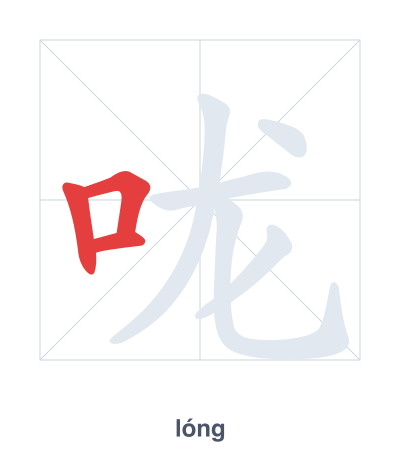
Open Hanzi Writer to see the animated stroke order and practice writing 咙 with real-time feedback.
The character 咙 (lóng) is written with 8 strokes. Follow the standard Chinese stroke order: top to bottom, left to right, outside before inside. The radical 口 is one of its key components.
Practice the correct stroke order with the Hanzi Writer app to see animated stroke-by-stroke guidance with real-time feedback.
咙 means throat.
As an HSK Level 7 character, 咙 is an intermediate-level character.
The character 咙 combines the mouth radical (口) indicating a bodily part related to the mouth, with the phonetic component 龙 (dragon). The dragon's long, winding shape suggests the passage of the throat or larynx.
💡 Memory Tip: Imagine a dragon (龙) opening its massive mouth (口) wide, revealing its powerful, rumbling throat.
我喉咙不舒服。
wǒ hóu lóng bù shū fú
My throat feels uncomfortable.
他今天喉咙痛。
tā jīn tiān hóu lóng tòng
He has a sore throat today.
多喝水,喉咙干。
duō hē shuǐ hóu lóng gàn
Drink more water; your throat is dry.
Open Hanzi Writer to see the animated stroke order and practice writing 咙 with real-time feedback.
✨ Animated stroke order · Handwriting recognition · HSK-graded practice · Free to use
咙 is made of the radical 口 (mouth) on the left and 龙 (dragon) on the right. The mouth radical connects to the throat as a part of the mouth area, while 龙 provides the pronunciation lóng. Together they form a character that specifically means "throat."