痨 (láo) means "tuberculosis; consumption" in Chinese. It has 12 strokes with the radical 疒.
Rated 4.2/5 in difficulty (advanced).
Appears in 3+ common words including 痨病 (láo bìng), 肺痨 (fèi láo), 痨疾 (láo jí).
Due to its 12 strokes, Hanzi Writer's error detection shows 痨 requires focused practice — most learners need 10+ attempts for consistent accuracy.
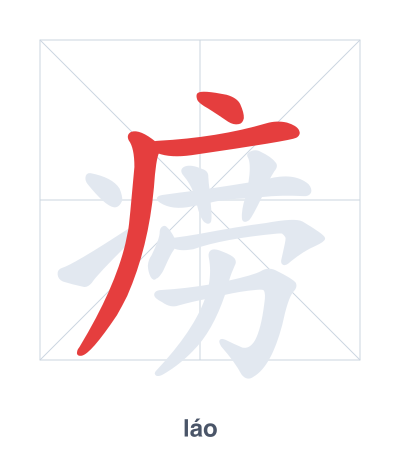
Open Hanzi Writer to see the animated stroke order and practice writing 痨 with real-time feedback.
The character 痨 (láo) is written with 12 strokes. Follow the standard Chinese stroke order: top to bottom, left to right, outside before inside. The radical 疒 is one of its key components.
Practice the correct stroke order with the Hanzi Writer app to see animated stroke-by-stroke guidance with real-time feedback.
痨 means tuberculosis; consumption.
痨 combines the radical 疒 (illness) with 劳 (labor, toil). The character suggests an illness caused by overwork, which historically referred to tuberculosis or consumption, a disease often associated with exhaustion.
💡 Memory Tip: Imagine a person (疒) working so hard (劳) that their lungs give out, coughing up blood from tuberculosis.
以前这种痨病很难治。
yǐ qián zhè zhǒng láo bìng hěn nán zhì
This kind of tuberculosis used to be very hard to cure.
肺痨是一种严重的病。
fèi láo shì yī zhǒng yán zhòng de bìng
Tuberculosis is a serious disease.
他不幸患上了痨疾。
tā bù xìng huàn shàng le láo jí
He unfortunately suffered from tuberculosis.
Open Hanzi Writer to see the animated stroke order and practice writing 痨 with real-time feedback.
✨ Animated stroke order · Handwriting recognition · HSK-graded practice · Free to use
The character 痨 has the radical 疒 (illness) on the outside, indicating it relates to disease. Inside is 劳 (láo, 'labor' or 'toil'), which gives the character its pronunciation and suggests that tuberculosis was seen as a wasting disease caused by overwork.