狼 (láng) means "wolf" in Chinese. It has 10 strokes with the radical 犭, and is HSK Level 7.
Rated 4.2/5 in difficulty (advanced).
Harder than 71% of HSK Level 7 characters.
Appears in 3+ common words including 大灰狼 (dà huī láng), 狼群 (láng qún), 色狼 (sè láng).
Due to its 10 strokes, Hanzi Writer's error detection shows 狼 requires focused practice — most learners need 10+ attempts for consistent accuracy.
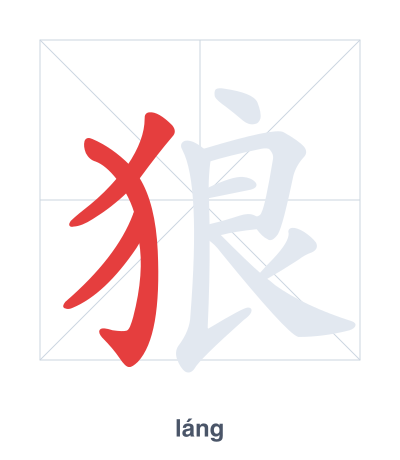
Open Hanzi Writer to see the animated stroke order and practice writing 狼 with real-time feedback.
The character 狼 (láng) is written with 10 strokes. Follow the standard Chinese stroke order: top to bottom, left to right, outside before inside. The radical 犭 is one of its key components.
Practice the correct stroke order with the Hanzi Writer app to see animated stroke-by-stroke guidance with real-time feedback.
狼 means wolf.
As an HSK Level 7 character, 狼 is an intermediate-level character.
The character 狼 is a semantic-phonetic compound: the left radical 犭 (animal/dog) indicates the creature is a canine, while the right component 良 (liáng) originally provided the sound. In ancient seal script, the animal radical depicted a dog-like figure, and the overall form represents a wolf—a wild, predatory canine.
💡 Memory Tip: Picture a wolf (犭) wearing a 'good' (良) disguise to lure its prey, revealing its cunning nature.
故事里有一只大灰狼。
gù shì lǐ yǒu yī zhī dà huī láng
There is a big bad wolf in the story.
狼群在森林里跑。
láng qún zài sēn lín lǐ pǎo
A pack of wolves is running in the forest.
离那个色狼远一点。
lí nà ge sè láng yuǎn yì diǎn
Stay away from that pervert.
Open Hanzi Writer to see the animated stroke order and practice writing 狼 with real-time feedback.
✨ Animated stroke order · Handwriting recognition · HSK-graded practice · Free to use
The left side is the radical 犭, which means 'dog' or 'animal', showing that 狼 is a kind of animal. The right side is 良 (liáng), which originally meant 'good' but here provides the sound. Together, the character means 'wolf'.