狉 (pī) means "A young fox or cub." in Chinese. It has 8 strokes with the radical 犭.
Rated 3.7/5 in difficulty (challenging).
Appears in 3+ common words including 狉狉 (pī pī), 狉子 (pī zi), 狉狉然 (pī pī rán).
Due to its 8 strokes, Hanzi Writer's error detection shows 狉 requires focused practice — most learners need 10+ attempts for consistent accuracy.
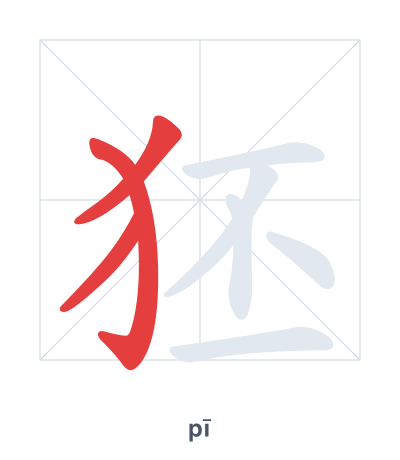
Open Hanzi Writer to see the animated stroke order and practice writing 狉 with real-time feedback.
The character 狉 (pī) is written with 8 strokes. Follow the standard Chinese stroke order: top to bottom, left to right, outside before inside. The radical 犭 is one of its key components.
Practice the correct stroke order with the Hanzi Writer app to see animated stroke-by-stroke guidance with real-time feedback.
狉 means A young fox or cub..
This character is a phono-semantic compound combining the animal radical 犭 (originally a dog) with the phonetic component 丕 (pī, meaning 'great' or 'large'). It specifically refers to a young fox or cub, a small canine-like creature.
💡 Memory Tip: A young fox (犭) is not (不) big (一) yet, so it's a cub.
狉狉是指幼小的野兽。
pī pī shì zhǐ yòu xiǎo de yě shòu
'Pin-pin' refers to young wild animals.
那只狉子在草丛里跑。
nà zhǐ pī zi zài cǎo cóng lǐ pǎo
That badger is running in the grass.
它呈现出狉狉然的样子。
tā chéng xiàn chū pī pī rán de yàng zi
It presents a wild and untamed appearance.
Open Hanzi Writer to see the animated stroke order and practice writing 狉 with real-time feedback.
✨ Animated stroke order · Handwriting recognition · HSK-graded practice · Free to use
狉 is a phono-semantic compound. The left radical 犭 (dog) indicates the character relates to animals, specifically canines. The right part 丕 (pī) provides the pronunciation and originally meant "great" or "big," but here it acts purely as a phonetic component, not directly related to the meaning "young fox."