烂 (làn) means "rotten; mushy; brilliant" in Chinese. It has 9 strokes with the radical 火, and is HSK Level 5.
Rated 4/5 in difficulty (challenging).
Harder than 53% of HSK Level 5 characters.
Appears in 3+ common words including 烂苹果 (làn píng guǒ), 破烂 (pò làn), 灿烂 (càn làn).
Due to its 9 strokes, Hanzi Writer's error detection shows 烂 requires focused practice — most learners need 10+ attempts for consistent accuracy.
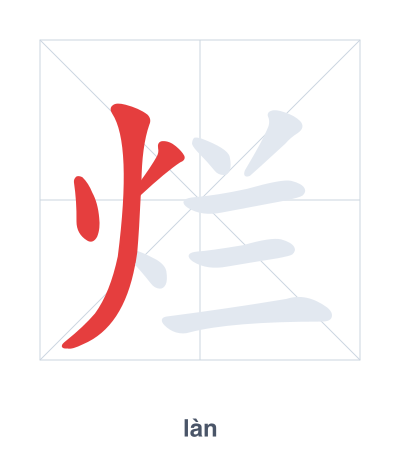
Open Hanzi Writer to see the animated stroke order and practice writing 烂 with real-time feedback.
The character 烂 (làn) is written with 9 strokes. Follow the standard Chinese stroke order: top to bottom, left to right, outside before inside. The radical 火 is one of its key components.
Practice the correct stroke order with the Hanzi Writer app to see animated stroke-by-stroke guidance with real-time feedback.
烂 means rotten; mushy; brilliant.
As an HSK Level 5 character, 烂 is an intermediate-level character.
This compound character combines the radical 'fire' (火) with the phonetic component 'orchid' (兰). Cooking food with too much fire can make it mushy or rotten, which gives the primary meaning; the sense of 'brilliant' likely comes from the brightness of flames.
💡 Memory Tip: Picture a fire (火) burning an orchid (兰) until it turns into a mushy, rotten mess.
垃圾桶里有一个已经变坏了的烂苹果。
lā jī tǒng lǐ yǒu yí gè yǐ jīng biàn huài le de làn píng guǒ 。
There is a rotten apple in the trash can.
他的衣服很破烂。
tā de yī fú hěn pò làn
His clothes are ragged.
阳光很灿烂。
yáng guāng hěn càn làn
The sunlight is very bright.
Open Hanzi Writer to see the animated stroke order and practice writing 烂 with real-time feedback.
✨ Animated stroke order · Handwriting recognition · HSK-graded practice · Free to use
烂 is formed by the radical 火 (fire) on the left and the phonetic component 兰 (lán) on the right. The fire radical links the character to heat or cooking, which can cause things to become soft or rotten. The right side 兰 provides the pronunciation làn.