扩 (kuò) means "to expand; to enlarge" in Chinese. It has 6 strokes with the radical 扌, and is HSK Level 4.
Rated 3.2/5 in difficulty (challenging).
Harder than 21% of HSK Level 4 characters.
Appears in 3+ common words including 扩大 (kuò dà), 扩音器 (kuò yīn qì), 扩张 (kuò zhāng).
Due to its 6 strokes, Hanzi Writer's error detection shows 扩 requires focused practice — most learners need 10+ attempts for consistent accuracy.
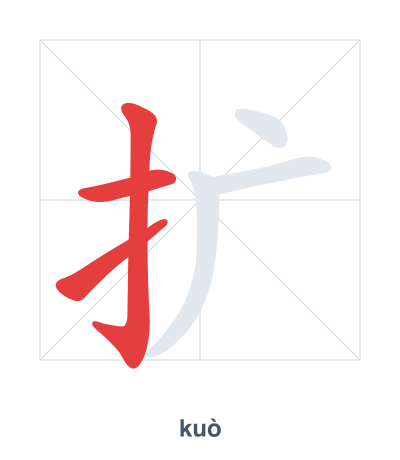
Open Hanzi Writer to see the animated stroke order and practice writing 扩 with real-time feedback.
The character 扩 (kuò) is written with 6 strokes. Follow the standard Chinese stroke order: top to bottom, left to right, outside before inside. The radical 扌 is one of its key components.
Practice the correct stroke order with the Hanzi Writer app to see animated stroke-by-stroke guidance with real-time feedback.
扩 means to expand; to enlarge.
As an HSK Level 4 character, 扩 is an intermediate-level character.
This character is a phono-semantic compound: the hand radical 扌 indicates an action, and 广 (guǎng) contributes the sound and the idea of 'broad' or 'wide'. Together, they evoke the sense of using your hands to make something wider—to expand or enlarge.
💡 Memory Tip: Picture your hand (扌) pushing outward to broaden (广) a narrow doorway, expanding the space.
公司扩大了规模。
gōng sī kuò dà le guī mó
The company expanded its scale.
请使用扩音器。
qǐng shǐ yòng kuò yīn qì
Please use a megaphone.
血管正在扩张。
xuè guǎn zhèng zài kuò zhāng
The blood vessels are dilating.
Open Hanzi Writer to see the animated stroke order and practice writing 扩 with real-time feedback.
✨ Animated stroke order · Handwriting recognition · HSK-graded practice · Free to use
The left side is the radical 扌, which means hand or action. The right side is 广, which means wide or broad. Together, they suggest using your hand to make something wider, so 扩 means to expand or enlarge.