喟 (kuì) means "To sigh" in Chinese. It has 12 strokes with the radical 口.
Rated 4.2/5 in difficulty (advanced).
Appears in 3+ common words including 喟叹 (kuì tàn), 喟然 (kuì rán), 喟然叹息 (kuì rán tàn xī).
Due to its 12 strokes, Hanzi Writer's error detection shows 喟 requires focused practice — most learners need 10+ attempts for consistent accuracy.
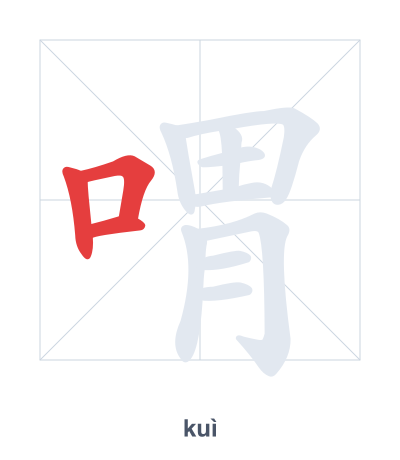
Open Hanzi Writer to see the animated stroke order and practice writing 喟 with real-time feedback.
The character 喟 (kuì) is written with 12 strokes. Follow the standard Chinese stroke order: top to bottom, left to right, outside before inside. The radical 口 is one of its key components.
Practice the correct stroke order with the Hanzi Writer app to see animated stroke-by-stroke guidance with real-time feedback.
喟 means To sigh.
喟 is a phono-semantic compound: the mouth radical (口) indicates the act of sighing, while the component 胃 (wèi, stomach) provides the pronunciation and hints at a deep sigh originating from the gut or stomach region.
💡 Memory Tip: Imagine a person sighing deeply (口) while clutching their stomach (胃) after eating too much.
他长长地喟叹一声。
tā cháng cháng dì kuì tàn yī shēng
He gave a long sigh.
他喟然长叹。
tā kuì rán cháng tàn
He let out a deep sigh.
听完故事他喟然叹息。
tīng wán gù shì tā kuì rán tàn xī
He sighed deeply after hearing the story.
Open Hanzi Writer to see the animated stroke order and practice writing 喟 with real-time feedback.
✨ Animated stroke order · Handwriting recognition · HSK-graded practice · Free to use
喟 is composed of the radical 口 (mouth) on the left side, which hints that the character relates to a sound made by the mouth. The right part is 胃 (wèi, stomach), which provides phonetic guidance and suggests a deep, internal feeling — together they form the idea of a sigh coming from the stomach.