窥 (kuī) means "peep / spy / pry" in Chinese. It has 13 strokes with the radical 穴, and is HSK Level 7.
Rated 4.2/5 in difficulty (advanced).
Harder than 78% of HSK Level 7 characters.
Appears in 3+ common words including 窥视 (kuī shì), 窥探 (kuī tàn), 偷窥 (tōu kuī).
Due to its 13 strokes, Hanzi Writer's error detection shows 窥 requires focused practice — most learners need 10+ attempts for consistent accuracy.
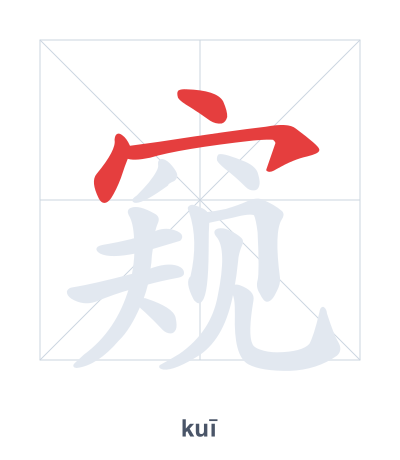
Open Hanzi Writer to see the animated stroke order and practice writing 窥 with real-time feedback.
The character 窥 (kuī) is written with 13 strokes. Follow the standard Chinese stroke order: top to bottom, left to right, outside before inside. The radical 穴 is one of its key components.
Practice the correct stroke order with the Hanzi Writer app to see animated stroke-by-stroke guidance with real-time feedback.
窥 means peep / spy / pry.
As an HSK Level 7 character, 窥 is an intermediate-level character.
The character 窥 combines the radical 穴 (cave) and the phonetic component 规 (compass/rule). The cave radical suggests looking through a hole or hidden spot, while 规 implies careful observation like using a compass, together meaning 'to peep or spy through a small opening'.
💡 Memory Tip: Imagine a person crouching in a cave (穴) holding a compass (规) to secretly peer through a crack and spy on someone.
不要窥视别人的隐私。
bú yào kuī shì bié rén de yǐn sī
Don't pry into others' privacy.
他在窥探敌人的行动。
tā zài kuī tàn dí rén de xíng dòng
He is spying on the enemy's movements.
偷窥是不礼貌的行为。
tōu kuī shì bù lǐ mào de xíng wéi
Peeping is impolite behavior.
Open Hanzi Writer to see the animated stroke order and practice writing 窥 with real-time feedback.
✨ Animated stroke order · Handwriting recognition · HSK-graded practice · Free to use
窥 has the radical 穴 (cave) on top, which relates to hiding or a secluded space, and the component 规 (gui, rule or pattern) underneath. Together, the idea is someone in a hidden place (穴) watching or following a pattern (规) — a peeping or spying action.