窒 (zhì) means "To obstruct, stop up, or suffocate." in Chinese. It has 11 strokes with the radical 穴, and is HSK Level 7.
Rated 4.2/5 in difficulty (advanced).
Harder than 77% of HSK Level 7 characters.
Appears in 3+ common words including 窒息 (zhì xī), 窒碍 (zhì ài), 气窒 (qì zhì).
Due to its 11 strokes, Hanzi Writer's error detection shows 窒 requires focused practice — most learners need 10+ attempts for consistent accuracy.
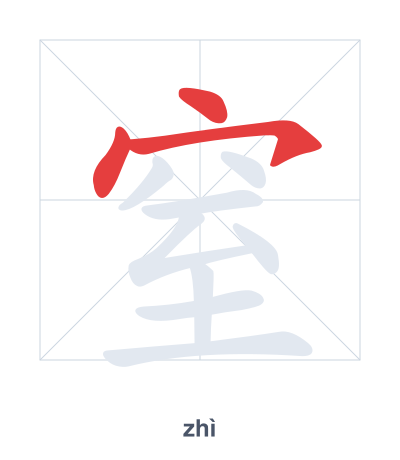
Open Hanzi Writer to see the animated stroke order and practice writing 窒 with real-time feedback.
The character 窒 (zhì) is written with 11 strokes. Follow the standard Chinese stroke order: top to bottom, left to right, outside before inside. The radical 穴 is one of its key components.
Practice the correct stroke order with the Hanzi Writer app to see animated stroke-by-stroke guidance with real-time feedback.
窒 means To obstruct, stop up, or suffocate..
As an HSK Level 7 character, 窒 is an intermediate-level character.
The character 窒 combines the radical 穴 (cave) with 至 (to arrive), suggesting something that arrives to fill or block a cave entrance. This composition conveys the idea of stopping up a passage or causing suffocation by obstruction.
💡 Memory Tip: Picture a person (至) crawling into a cave (穴) only to find the entrance sealed shut, trapping them inside to suffocate.
让人感到窒息。
ràng rén gǎn dào zhì xī
It makes one feel suffocated.
计划毫无窒碍。
jì huà háo wú zhì ài
The plan is proceeding without any obstacles.
感到胸口气窒。
gǎn dào xiōng kǒu qì zhì
To feel a tightness in the chest.
Open Hanzi Writer to see the animated stroke order and practice writing 窒 with real-time feedback.
✨ Animated stroke order · Handwriting recognition · HSK-graded practice · Free to use
The character 窒 is made of the radical 穴 (cave or hole) on top and 至 (to arrive) below. Together they suggest arriving at a cave that is blocked or suffocating, which gives the meaning of obstructing or suffocating.