怕 (pà) means "to fear; to be afraid" in Chinese. It has 8 strokes with the radical 忄, and is HSK Level 2.
Rated 3.2/5 in difficulty (challenging).
Harder than 48% of HSK Level 2 characters.
Appears in 3+ common words including 害怕 (hài pà), 哪怕 (nǎ pà), 恐怕 (kǒng pà).
Due to its 8 strokes, Hanzi Writer's error detection shows 怕 requires focused practice — most learners need 10+ attempts for consistent accuracy.
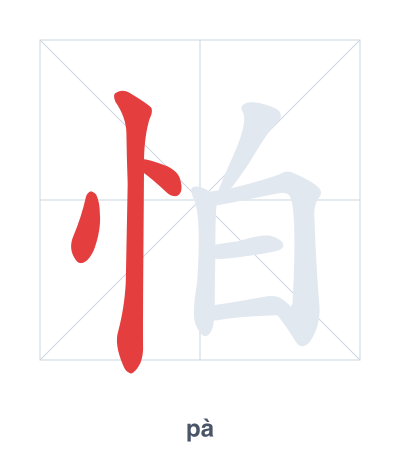
Open Hanzi Writer to see the animated stroke order and practice writing 怕 with real-time feedback.
The character 怕 (pà) is written with 8 strokes. Follow the standard Chinese stroke order: top to bottom, left to right, outside before inside. The radical 忄 is one of its key components.
Practice the correct stroke order with the Hanzi Writer app to see animated stroke-by-stroke guidance with real-time feedback.
怕 means to fear; to be afraid.
As an HSK Level 2 character, 怕 is among the first characters beginners learn.
怕 is a phono-semantic compound. The left radical 忄 (heart) conveys that fear is an emotion felt in the heart, while the right component 白 (white) hints at its pronunciation (pà) and suggests the idea of turning pale with fear.
💡 Memory Tip: Picture a heart (忄) turning completely white (白) because it is terrified.
我很害怕看鬼片。
wǒ hěn hài pà kàn guǐ piàn
I'm very afraid of watching horror movies.
哪怕下雨我也要去。
nǎ pà xià yǔ wǒ yě yào qù
Even if it rains, I will go.
恐怕他今天不来了。
kǒng pà tā jīn tiān bù lái le
I'm afraid he won't come today.
Open Hanzi Writer to see the animated stroke order and practice writing 怕 with real-time feedback.
✨ Animated stroke order · Handwriting recognition · HSK-graded practice · Free to use
怕 is made of two parts: the left radical 忄 (heart) and the right component 白 (bái, meaning white). The heart radical shows that the character relates to emotions or feelings, while 白 gives the sound pà. Together they create the idea of a heart turning white or pale from fear.