怖 (bù) means "terror; fear; frightened" in Chinese. It has 8 strokes with the radical 忄, and is HSK Level 7.
Rated 3.7/5 in difficulty (challenging).
Harder than 25% of HSK Level 7 characters.
Appears in 3+ common words including 恐怖 (kǒng bù), 惊怖 (jīng bù), 恐怖片 (kǒng bù piàn).
Due to its 8 strokes, Hanzi Writer's error detection shows 怖 requires focused practice — most learners need 10+ attempts for consistent accuracy.
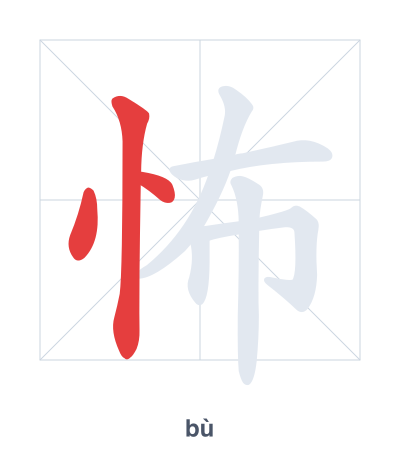
Open Hanzi Writer to see the animated stroke order and practice writing 怖 with real-time feedback.
The character 怖 (bù) is written with 8 strokes. Follow the standard Chinese stroke order: top to bottom, left to right, outside before inside. The radical 忄 is one of its key components.
Practice the correct stroke order with the Hanzi Writer app to see animated stroke-by-stroke guidance with real-time feedback.
怖 means terror; fear; frightened.
As an HSK Level 7 character, 怖 is an intermediate-level character.
怖 combines the heart radical 忄 (心), indicating emotion, with 布 (bù, 'cloth'), which serves as a phonetic component. The cloth suggests something that spreads or covers, evoking the idea of fear that envelops or 'clothes' the heart in dread.
💡 Memory Tip: Imagine your heart (忄) is suddenly wrapped in a suffocating cloth (布), causing instant terror.
这个电影很恐怖。
zhè ge diàn yǐng hěn kǒng bù
This movie is very scary.
他的眼神充满惊怖。
tā de yǎn shén chōng mǎn jīng bù
His eyes are full of terror.
我不敢看恐怖片。
wǒ bù gǎn kàn kǒng bù piàn
I'm afraid to watch horror movies.
Open Hanzi Writer to see the animated stroke order and practice writing 怖 with real-time feedback.
✨ Animated stroke order · Handwriting recognition · HSK-graded practice · Free to use
怖 is made of the heart radical 忄 on the left and the character 布 (bù, cloth) on the right. The heart radical suggests emotion, and together they indicate a feeling of fear that can make one's heart feel covered or pressed, like with a cloth. This structure visually links fear to the heart.