胀 (zhàng) means "Bloated / Distended" in Chinese. It has 8 strokes with the radical ⺼, and is HSK Level 7.
Rated 3.7/5 in difficulty (challenging).
Harder than 30% of HSK Level 7 characters.
Appears in 3+ common words including 肚子胀 (dǔ zi zhàng), 膨胀 (péng zhàng), 胀痛 (zhàng tòng).
Due to its 8 strokes, Hanzi Writer's error detection shows 胀 requires focused practice — most learners need 10+ attempts for consistent accuracy.
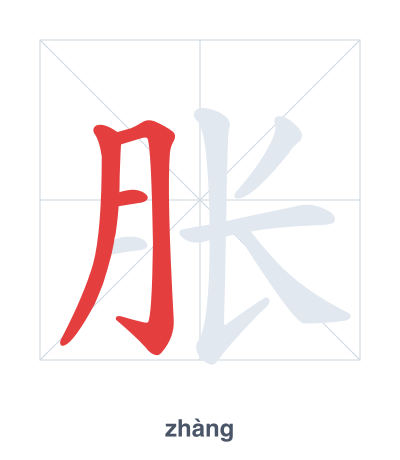
Open Hanzi Writer to see the animated stroke order and practice writing 胀 with real-time feedback.
The character 胀 (zhàng) is written with 8 strokes. Follow the standard Chinese stroke order: top to bottom, left to right, outside before inside. The radical ⺼ is one of its key components.
Practice the correct stroke order with the Hanzi Writer app to see animated stroke-by-stroke guidance with real-time feedback.
胀 means Bloated / Distended.
As an HSK Level 7 character, 胀 is an intermediate-level character.
The character 胀 combines the flesh radical ⺼ (meat/body) with 长 (long/grow), indicating flesh that expands or lengthens, leading to a bloated or distended feeling.
💡 Memory Tip: Picture a belly (⺼) stretching long (长) like a balloon about to pop, feeling bloated.
我吃得太多,肚子胀。
wǒ chī dé tài duō dǔ zi zhàng
I ate too much and feel bloated.
气球受热会膨胀。
qì qiú shòu rè huì péng zhàng
Balloons expand when heated.
他的胃有点胀痛。
tā de wèi yǒu diǎn zhàng tòng
His stomach feels a bit bloated and painful.
Open Hanzi Writer to see the animated stroke order and practice writing 胀 with real-time feedback.
✨ Animated stroke order · Handwriting recognition · HSK-graded practice · Free to use
胀 is made of the radical ⺼ (flesh/meat) on the left and 长 (zhǎng, to grow or long) on the right. The flesh radical shows the meaning involves the body, while 长 suggests stretching or expanding, together creating the idea of a body part becoming bloated or distended.