拒 (jù) means "To resist / To refuse" in Chinese. It has 7 strokes with the radical 扌, and is HSK Level 5.
Rated 3.5/5 in difficulty (challenging).
Harder than 25% of HSK Level 5 characters.
Appears in 3+ common words including 拒绝 (jù jué), 拒付 (jù fù), 拒收 (jù shōu).
Due to its 7 strokes, Hanzi Writer's error detection shows 拒 requires focused practice — most learners need 10+ attempts for consistent accuracy.
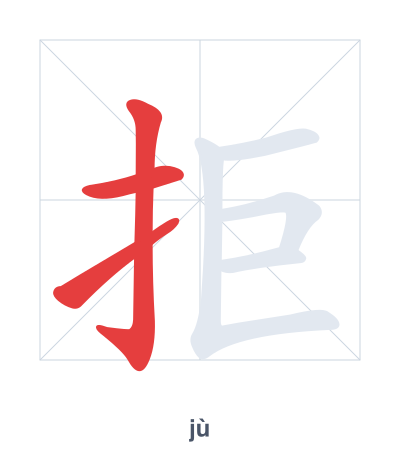
Open Hanzi Writer to see the animated stroke order and practice writing 拒 with real-time feedback.
The character 拒 (jù) is written with 7 strokes. Follow the standard Chinese stroke order: top to bottom, left to right, outside before inside. The radical 扌 is one of its key components.
Practice the correct stroke order with the Hanzi Writer app to see animated stroke-by-stroke guidance with real-time feedback.
拒 means To resist / To refuse.
As an HSK Level 5 character, 拒 is an intermediate-level character.
拒 combines the hand radical 扌 with 巨 (jù, 'huge'), which acts as a phonetic. The hand radical indicates an action, and the overall meaning of 'to resist' or 'refuse' suggests pushing away or blocking with the hand.
💡 Memory Tip: Imagine a giant hand (扌) with a huge (巨) palm raised to block and say 'No!'
她拒绝了我的请求。
tā jù jué le wǒ de qǐng qiú
She rejected my request.
他拒付这笔费用。
tā jù fù zhè bǐ fèi yòng
He refused to pay this fee.
快递被拒收了。
kuài dì bèi jù shōu le
The delivery was rejected.
Open Hanzi Writer to see the animated stroke order and practice writing 拒 with real-time feedback.
✨ Animated stroke order · Handwriting recognition · HSK-graded practice · Free to use
拒 is made of two parts: the left radical 扌 (hand) and the right part 巨 (meaning huge or giant). The hand (扌) pushing against something huge (巨) suggests the action of resisting or refusing with force.