噱 (jué/xué) means "To laugh / Gimmick" in Chinese. It has 16 strokes with the radical 口.
Rated 4.2/5 in difficulty (advanced).
Appears in 3+ common words including 噱头 (xué tou), 发噱 (fā jué), 噱而不俗 (jué ér bù sú).
Due to its 16 strokes, Hanzi Writer's error detection shows 噱 requires focused practice — most learners need 10+ attempts for consistent accuracy.
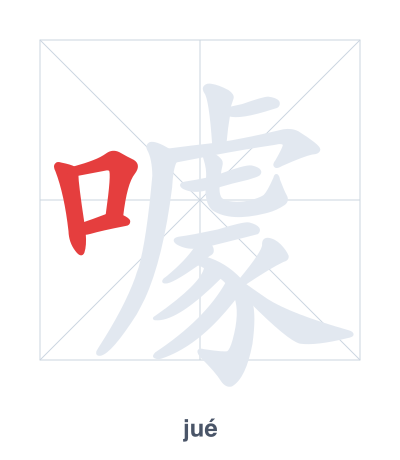
Open Hanzi Writer to see the animated stroke order and practice writing 噱 with real-time feedback.
The character 噱 (jué/xué) is written with 16 strokes. Follow the standard Chinese stroke order: top to bottom, left to right, outside before inside. The radical 口 is one of its key components.
Practice the correct stroke order with the Hanzi Writer app to see animated stroke-by-stroke guidance with real-time feedback.
噱 means To laugh / Gimmick.
This is a polyphonic character with readings: jué, xué.
噱 is a compound character with the mouth radical (口) indicating an action related to the mouth, and the phonetic component 豦 (jué, originally depicting a tiger-pig beast) providing sound and a hint of exaggerated or crude laughter. This combination came to represent a loud laugh or a gimmick designed to provoke laughter.
💡 Memory Tip: Picture a mouth (口) roaring with laughter at a ridiculous tiger-pig creature (豦) performing a silly gimmick.
这只是一个噱头。
zhè zhǐ shì yí gè xué tou
This is just a gimmick.
他的话令人发噱。
tā de huà lìng rén fā jué
His words were laughable.
这个笑话噱而不俗。
zhè ge xiào huà jué ér bù sú
This joke is funny without being vulgar.
Open Hanzi Writer to see the animated stroke order and practice writing 噱 with real-time feedback.
✨ Animated stroke order · Handwriting recognition · HSK-graded practice · Free to use
噱 is made of the radical 口 (mouth) on the left and the phonetic component 豦 on the right. The mouth radical suggests the character involves speech or sound, which connects to laughing or making a gimmick. The phonetic part gives a clue to its pronunciation (jué).