Hanzi Writer

How to Write 踽 (jǔ) — Meaning “walking alone”

16 strokes Radical: 足

踽 (jǔ) means "walking alone" in Chinese. It has 16 strokes with the radical 足.

Rated 4.2/5 in difficulty (advanced).

Appears in 3+ common words including 踽踽独行 (jǔ jǔ dú xíng), 踽踽 (jǔ jǔ), 独行 (dú xíng).

Due to its 16 strokes, Hanzi Writer's error detection shows 踽 requires focused practice — most learners need 10+ attempts for consistent accuracy.
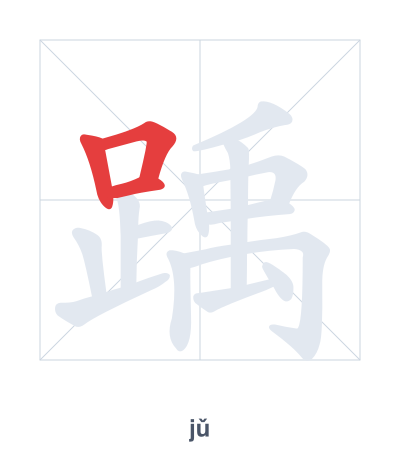
Stroke order practice for 踽 - jǔ

Practice Writing 踽 (jǔ)

Open Hanzi Writer to see the animated stroke order and practice writing 踽 with real-time feedback.

The character (jǔ) is written with 16 strokes. Follow the standard Chinese stroke order: top to bottom, left to right, outside before inside. The radical is one of its key components.

Practice the correct stroke order with the Hanzi Writer app to see animated stroke-by-stroke guidance with real-time feedback.

means walking alone.

Character
Pinyinjǔ (ju)
Meaningwalking alone
Strokes16
Radical
Difficulty4.2/5

踽 is a phono-semantic compound: the radical 足 (foot) indicates walking, and the component 禹 (yǔ) provides the pronunciation. The meaning 'walking alone' comes from classical usage, where it describes a solitary gait, as in the phrase '踽踽独行' (to walk alone).

💡 Memory Tip: Imagine a lonely figure with big feet (足) walking slowly, dragging a heavy 'rainbow' (the 禹 component looks like a winding path with a tail) — that person is 踽, walking alone.

jǔ jǔ dú xíng
to walk alone; to be solitary
jǔ jǔ
solitary; walking alone
dú xíng
to walk alone

他一个人在街上踽踽独行。

tā yí gè rén zài jiē shàng jǔ jǔ dú xíng

He is walking all alone on the street.

老人踽踽走在小路上。

lǎo rén jǔ jǔ zǒu zài xiǎo lù shàng

The elderly person is walking alone on the path.

他喜欢踽踽独行的感觉。

tā xǐ huān jǔ jǔ dú xíng de gǎn jué

He likes the feeling of walking alone.

Character Pinyin Strokes Radical
(current) 16
tāng 15
14
xué 14
Stroke order practice for 踽 - jǔ

Practice Writing 踽 (jǔ)

Open Hanzi Writer to see the animated stroke order and practice writing 踽 with real-time feedback.

✨ Animated stroke order · Handwriting recognition · HSK-graded practice · Free to use

Frequently Asked Questions about 踽

踽 is formed by the radical 足 (foot) on the left and the component 禹 on the right. The radical 足 indicates the meaning relates to walking, while 禹 provides pronunciation. Together, they create the idea of walking alone.

Characters with Radical 足

Other 16-Stroke Characters