咎 (jiù) means "fault; blame" in Chinese. It has 8 strokes with the radical 口.
Rated 3.7/5 in difficulty (challenging).
Appears in 3+ common words including 归咎 (guī jiù), 既往不咎 (jì wǎng bù jiù), 咎由自取 (jiù yóu zì qǔ).
Due to its 8 strokes, Hanzi Writer's error detection shows 咎 requires focused practice — most learners need 10+ attempts for consistent accuracy.
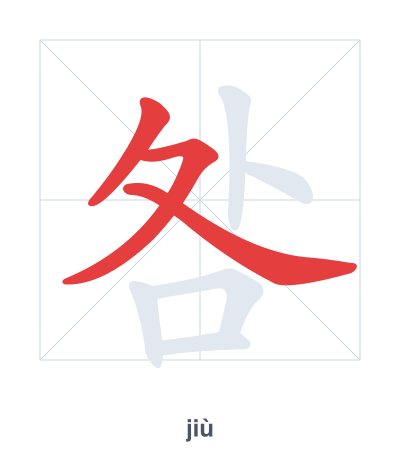
Open Hanzi Writer to see the animated stroke order and practice writing 咎 with real-time feedback.
The character 咎 (jiù) is written with 8 strokes. Follow the standard Chinese stroke order: top to bottom, left to right, outside before inside. The radical 口 is one of its key components.
Practice the correct stroke order with the Hanzi Writer app to see animated stroke-by-stroke guidance with real-time feedback.
咎 means fault; blame.
咎 is a compound character, combining 处 (a person with a foot, suggesting action) above 口 (mouth). Together, they imply that faults or blame arise from a person's words and deeds.
💡 Memory Tip: Picture a person (处) stepping on a mouth (口) that is accusing them—that's the fault (咎).
别把错归咎于他。
bié bǎ cuò guī jiù yú tā
Don't blame the mistake on him.
我们既往不咎。
wǒ men jì wǎng bù jiù
We will let bygones be bygones.
这是他咎由自取。
zhè shì tā jiù yóu zì qǔ
This is his own fault.
Open Hanzi Writer to see the animated stroke order and practice writing 咎 with real-time feedback.
✨ Animated stroke order · Handwriting recognition · HSK-graded practice · Free to use
The character 咎 combines the radical 口 (mouth) on top with 夂 (a variant of 止 meaning 'stop') below. The mouth suggests speech or accusation, while the lower part implies stopping or restricting, together indicating 'to blame' or 'fault' through the idea of verbal reproach that halts someone.