毛 (máo) means "Hair; fur; feather" in Chinese. It has 4 strokes with the radical 毛, and is HSK Level 1.
Rated 1.5/5 in difficulty (beginner-friendly).
Harder than 5% of HSK Level 1 characters.
Appears in 3+ common words including 毛笔 (máo bǐ), 羊毛 (yáng máo), 毛衣 (máo yī).
In the Hanzi Writer app, most learners master 毛 within 3 practice attempts using stroke-by-stroke animation.
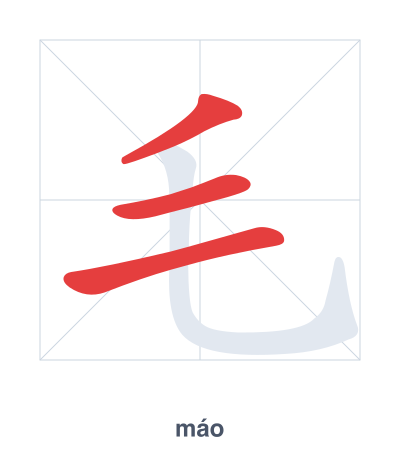
Open Hanzi Writer to see the animated stroke order and practice writing 毛 with real-time feedback.
The character 毛 (máo) is written with 4 strokes. Follow the standard Chinese stroke order: top to bottom, left to right, outside before inside. The radical 毛 is one of its key components.
Practice the correct stroke order with the Hanzi Writer app to see animated stroke-by-stroke guidance with real-time feedback.
毛 means Hair; fur; feather.
As an HSK Level 1 character, 毛 is among the first characters beginners learn.
The character 毛 originated as a pictograph of a feather or a tuft of hair, with early forms showing a feather's central shaft and barbs. Over time, it simplified into the modern shape, which still suggests strands or a bundle of hair, fur, or feathers.
💡 Memory Tip: Picture the top three strokes as three hairs sprouting from a head, with the bottom hook as the curve of a single curly strand.
我用毛笔写字。
wǒ yòng máo bǐ xiě zì
I use a brush to write.
这是纯羊毛的。
zhè shì chún yáng máo de
This is pure wool.
妈妈给我织了毛衣。
mā mā gěi wǒ zhī le máo yī
Mom knitted a sweater for me.
Open Hanzi Writer to see the animated stroke order and practice writing 毛 with real-time feedback.
✨ Animated stroke order · Handwriting recognition · HSK-graded practice · Free to use
The character 毛 is a pictograph that resembles a feather or tuft of hair. Its top part looks like a few strands, and the curved bottom represents a tail or base. This simple shape directly conveys the idea of soft, fine growth on animals or humans.