帏 (wéi) means "curtain; screen" in Chinese. It has 7 strokes with the radical 巾.
Rated 3.5/5 in difficulty (challenging).
Appears in 3+ common words including 帏帐 (wéi zhàng), 帏幕 (wéi mù), 罗帏 (luó wéi).
Due to its 7 strokes, Hanzi Writer's error detection shows 帏 requires focused practice — most learners need 10+ attempts for consistent accuracy.
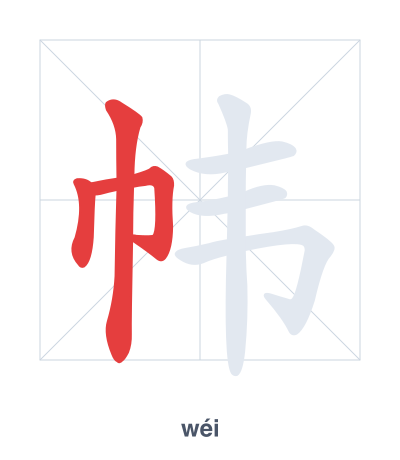
Open Hanzi Writer to see the animated stroke order and practice writing 帏 with real-time feedback.
The character 帏 (wéi) is written with 7 strokes. Follow the standard Chinese stroke order: top to bottom, left to right, outside before inside. The radical 巾 is one of its key components.
Practice the correct stroke order with the Hanzi Writer app to see animated stroke-by-stroke guidance with real-time feedback.
帏 means curtain; screen.
帏 is a phono-semantic compound. The radical 巾 (cloth) indicates its meaning as a fabric curtain or screen, while the component 韦 (wéi, leather) provides the pronunciation and also evokes the idea of a hide or covering, reinforcing the sense of something that blocks or encloses.
💡 Memory Tip: Imagine a curtain made of cloth (巾) that is so heavy it has to be hung with a leather strap (韦) across the window.
床上挂着帏帐。
chuáng shàng guà zhe wéi zhàng
Curtains are hanging over the bed.
舞台的帏幕拉开了。
wǔ tái de wéi mù lā kāi le
The stage curtain was drawn.
罗帏里很安静。
luó wéi lǐ hěn ān jìng
It is very quiet inside the silk curtains.
Open Hanzi Writer to see the animated stroke order and practice writing 帏 with real-time feedback.
✨ Animated stroke order · Handwriting recognition · HSK-graded practice · Free to use
帏 is a left-right character. The left part is the radical 巾 (cloth), which gives the meaning of fabric or textile. The right part is 韦 (wéi), which provides the pronunciation and originally meant 'leather', but together they form the idea of a cloth curtain or screen.