揭 (jiē) means "to uncover; to reveal" in Chinese. It has 12 strokes with the radical 扌, and is HSK Level 6.
Rated 4.2/5 in difficulty (advanced).
Harder than 65% of HSK Level 6 characters.
Appears in 3+ common words including 揭开 (jiē kāi), 揭晓 (jiē xiǎo), 揭穿 (jiē chuān).
Due to its 12 strokes, Hanzi Writer's error detection shows 揭 requires focused practice — most learners need 10+ attempts for consistent accuracy.
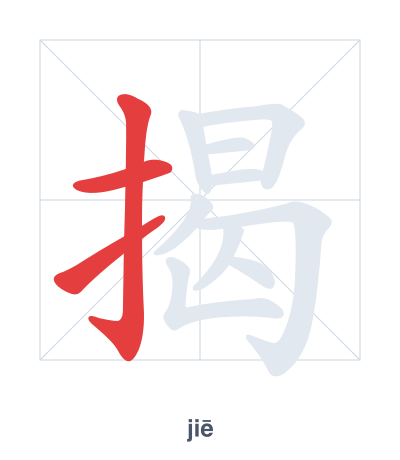
Open Hanzi Writer to see the animated stroke order and practice writing 揭 with real-time feedback.
The character 揭 (jiē) is written with 12 strokes. Follow the standard Chinese stroke order: top to bottom, left to right, outside before inside. The radical 扌 is one of its key components.
Practice the correct stroke order with the Hanzi Writer app to see animated stroke-by-stroke guidance with real-time feedback.
揭 means to uncover; to reveal.
As an HSK Level 6 character, 揭 is an intermediate-level character.
揭 combines the hand radical 扌 (action) with 曷, a phonetic component that originally depicted a person speaking or shouting, suggesting the idea of lifting a cover to reveal something. The hand (扌) performs the action of uncovering or raising, while 曷 contributes the sound and a hint of 'exposing' through vocal expression. Together, they form the concept of physically or metaphorically lifting a veil to disclose what's hidden.
💡 Memory Tip: Imagine a hand (扌) grabbing the corner of a heavy cloth (曷 looks like a covered jar) and yanking it off in one swift motion to reveal a secret underneath.
揭开盒子的盖子。
jiē kāi hé zi de gài zi
Open the lid of the box.
比赛结果揭晓了。
bǐ sài jié guǒ jiē xiǎo le
The competition results have been announced.
谎言被揭穿了。
huǎng yán bèi jiē chuān le
The lie was debunked.
Open Hanzi Writer to see the animated stroke order and practice writing 揭 with real-time feedback.
✨ Animated stroke order · Handwriting recognition · HSK-graded practice · Free to use
揭 is made of the radical 扌 (hand) on the left, which suggests an action done with the hand. The right part 曷 (hé) gives the sound and originally related to "to stop" or "why," but here it combines with the hand to suggest using your hand to lift or remove a cover, thus "to uncover."