弛 (chí) means "to relax or loosen" in Chinese. It has 6 strokes with the radical 弓, and is HSK Level 7.
Rated 3.2/5 in difficulty (challenging).
Harder than 10% of HSK Level 7 characters.
Appears in 3+ common words including 松弛 (sōng chí), 废弛 (fèi chí), 张弛 (zhāng chí).
Due to its 6 strokes, Hanzi Writer's error detection shows 弛 requires focused practice — most learners need 10+ attempts for consistent accuracy.
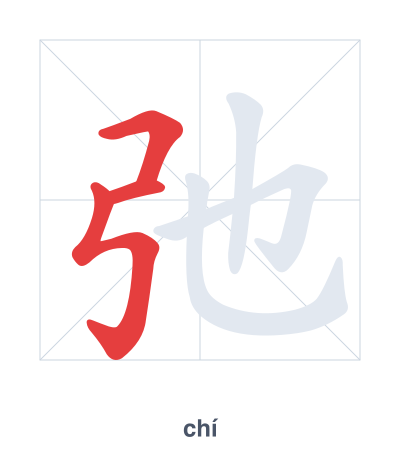
Open Hanzi Writer to see the animated stroke order and practice writing 弛 with real-time feedback.
The character 弛 (chí) is written with 6 strokes. Follow the standard Chinese stroke order: top to bottom, left to right, outside before inside. The radical 弓 is one of its key components.
Practice the correct stroke order with the Hanzi Writer app to see animated stroke-by-stroke guidance with real-time feedback.
弛 means to relax or loosen.
As an HSK Level 7 character, 弛 is an intermediate-level character.
The character 弛 combines the radical 弓 (bow) with the phonetic component 也. It originally depicted the action of unstringing a bow, so the bow's tension is released, conveying the meaning of relaxing or loosening.
💡 Memory Tip: Picture a bow (弓) that has been loosened so much it droops into the shape of 也, like a relaxed snake.
运动后肌肉很松弛。
yùn dòng hòu jī ròu hěn sōng chí
Muscles are relaxed after exercise.
这里的纪律有些废弛。
zhè lǐ de jì lǜ yǒu xiē fèi chí
The discipline here is somewhat lax.
生活要讲究张弛有度。
shēng huó yào jiǎng jiū zhāng chí yǒu dù
Life should have a balance between work and relaxation.
Open Hanzi Writer to see the animated stroke order and practice writing 弛 with real-time feedback.
✨ Animated stroke order · Handwriting recognition · HSK-graded practice · Free to use
弛 is composed of the radical 弓 (a bow) on the left and 也 (also/all the same) on the right. The bow radical suggests tension, and adding 也 implies something that also becomes loose, so together it means to relax or loosen a bowstring.