剑 (jiàn) means "Sword" in Chinese. It has 9 strokes with the radical 刂, and is HSK Level 6.
Rated 3.7/5 in difficulty (challenging).
Harder than 23% of HSK Level 6 characters.
Appears in 3+ common words including 击剑 (jī jiàn), 宝剑 (bǎo jiàn), 剑法 (jiàn fǎ).
Due to its 9 strokes, Hanzi Writer's error detection shows 剑 requires focused practice — most learners need 10+ attempts for consistent accuracy.
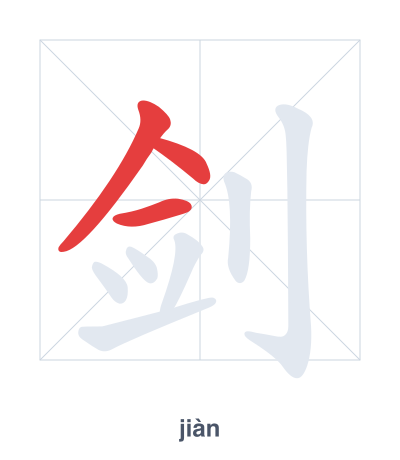
Open Hanzi Writer to see the animated stroke order and practice writing 剑 with real-time feedback.
The character 剑 (jiàn) is written with 9 strokes. Follow the standard Chinese stroke order: top to bottom, left to right, outside before inside. The radical 刂 is one of its key components.
Practice the correct stroke order with the Hanzi Writer app to see animated stroke-by-stroke guidance with real-time feedback.
剑 means Sword.
As an HSK Level 6 character, 剑 is an intermediate-level character.
剑 is a phono-semantic compound. The left component 佥 (qiān) provides the sound, while the right component 刂 (knife radical) indicates a cutting tool. The character originally referred to a double-edged sword, combining a phonetic element with the meaning of a bladed weapon.
💡 Memory Tip: Picture the left side 佥 as the sword's hilt and crossguard, and the right side 刂 as the sharp blade.
他喜欢练习击剑。
tā xǐ huān liàn xí jī jiàn
He likes practicing fencing.
这是一把古代宝剑。
zhè shì yī bǎ gǔ dài bǎo jiàn
This is an ancient precious sword.
他的剑法很高明。
tā de jiàn fǎ hěn gāo míng
His swordsmanship is superb.
Open Hanzi Writer to see the animated stroke order and practice writing 剑 with real-time feedback.
✨ Animated stroke order · Handwriting recognition · HSK-graded practice · Free to use
The character 剑 is composed of the phonetic component 佥 on the left and the radical 刂 (knife) on the right. The radical 刂 indicates that a sword is a cutting tool. The left part 佥 provides the pronunciation jiàn and also suggests the idea of "both sides" — a sword has two edges.