腮 (sāi) means "cheek" in Chinese. It has 13 strokes with the radical 月.
Rated 4.2/5 in difficulty (advanced).
Appears in 3+ common words including 腮帮子 (sāi bāng zi), 鱼腮 (yú sāi), 腮红 (sāi hóng).
Due to its 13 strokes, Hanzi Writer's error detection shows 腮 requires focused practice — most learners need 10+ attempts for consistent accuracy.
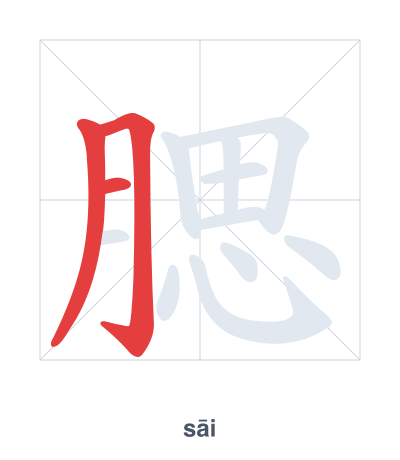
Open Hanzi Writer to see the animated stroke order and practice writing 腮 with real-time feedback.
The character 腮 (sāi) is written with 13 strokes. Follow the standard Chinese stroke order: top to bottom, left to right, outside before inside. The radical 月 is one of its key components.
Practice the correct stroke order with the Hanzi Writer app to see animated stroke-by-stroke guidance with real-time feedback.
腮 means cheek.
The character 腮 is a phono-semantic compound: the radical 月 (meat/flesh) indicates it relates to a body part, while the component 思 (sī, 'to think') provides the pronunciation (sāi). Together they form the word for 'cheek'.
💡 Memory Tip: Picture your cheek (腮) as the place where you rest your hand while thinking (思) deeply.
他的腮帮子红了。
tā de sāi bāng zi hóng le
His cheeks turned red.
鱼用鱼腮呼吸。
yú yòng yú sāi hū xī
Fish breathe through their gills.
她涂了一点腮红。
tā tú le yì diǎn sāi hóng
She applied a bit of blush.
Open Hanzi Writer to see the animated stroke order and practice writing 腮 with real-time feedback.
✨ Animated stroke order · Handwriting recognition · HSK-graded practice · Free to use
腮 has the radical 月 (meat/flesh) on the left, showing it relates to body parts. The right side is 思 (sī, think), which gives the sound. Together, 腮 means 'cheek,' a fleshy part of the face.