缉 (jī) means "to arrest / to seize / to stitch" in Chinese. It has 12 strokes with the radical 纟, and is HSK Level 7.
Rated 4.2/5 in difficulty (advanced).
Harder than 81% of HSK Level 7 characters.
Appears in 3+ common words including 缉拿 (jī ná), 侦缉 (zhēn jī), 缉鞋口 (jī xié kǒu).
Due to its 12 strokes, Hanzi Writer's error detection shows 缉 requires focused practice — most learners need 10+ attempts for consistent accuracy.
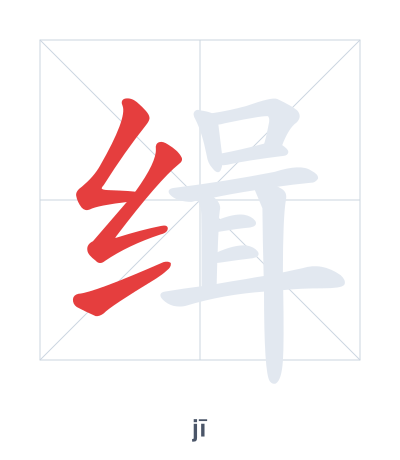
Open Hanzi Writer to see the animated stroke order and practice writing 缉 with real-time feedback.
The character 缉 (jī) is written with 12 strokes. Follow the standard Chinese stroke order: top to bottom, left to right, outside before inside. The radical 纟 is one of its key components.
Practice the correct stroke order with the Hanzi Writer app to see animated stroke-by-stroke guidance with real-time feedback.
缉 means to arrest / to seize / to stitch.
As an HSK Level 7 character, 缉 is an intermediate-level character.
缉 is a phono-semantic compound combining the silk radical 纟 (thread) with 咠 (qì, meaning 'to whisper in the ear') as a phonetic. The original meaning was 'to stitch' or 'sew', using silk thread to bind fabric; later it extended to 'arrest' or 'seize', like stitching up a criminal in a net.
💡 Memory Tip: Picture a cop using a silk thread (纟) to tie up a criminal's ear (耳) and mouth (口) to arrest (缉) them.
警方正在全力缉拿在逃的犯罪嫌疑人。
jǐng fāng zhèng zài quán lì jī ná zài táo de fàn zuì xián yí rén
The police are making every effort to arrest the criminal suspect on the run.
这位老侦察员有着丰富的侦缉工作经验。
zhè wèi lǎo zhēn chá yuán yǒu zhe fēng fù de zhēn jī gōng zuò jīng yàn
This veteran scout has extensive experience in criminal investigation.
奶奶戴着老花镜,正在灯下仔细地缉鞋口。
nǎi nǎi dài zhe lǎo huā jìng zhèng zài dēng xià zǐ xì dì jī xié kǒu
Wearing reading glasses, Grandma is carefully stitching the edge of a shoe under the lamp.
Open Hanzi Writer to see the animated stroke order and practice writing 缉 with real-time feedback.
✨ Animated stroke order · Handwriting recognition · HSK-graded practice · Free to use
缉 is composed of the silk radical 纟 on the left and the phonetic element 咠 (qì) on the right. The silk radical connects to the meaning 'to stitch' because stitching involves thread, while the arrest meaning likely developed from the idea of tying up a criminal with rope.